Cómo elegir finca para boda: qué preguntar antes de firmar
Cómo elegir finca para boda: primero los invitados, después plazas sentadas, precios 2026, regla del catering, fin de la música, plan B y qué preguntar.
El equipo de Eventadore11 min de lecturaActualizado el 26 de octubre de 2026
To choose a wedding venue, fix your guest count and your budget first, then your date or season, and only then shortlist places that seat that number for dinner — seated, not standing. Before you sign, get in writing what the price includes, whether you may bring your own caterer, when the music has to stop, where everyone goes if it rains, any minimum spend and what happens if either side cancels.
The venue, with its food and drink, is usually the largest part of a wedding budget, and it decides much of the rest: your caterer, your band's volume, the shape of your day.
Start with your guest count, then your date
Your number decides everything. A room that feels perfect for 60 is wrong for 140. Make a first wedding guest list before you visit anywhere; a rough one with an A list and a B list is enough to give you a range, say 80 to 95.
Then the date. Saturdays from May to September go first, and popular venues are often booked a year or more ahead for them. Fridays, Sundays and the months from October to April are usually cheaper and easier to get. If your date is flexible, ask each venue which dates it still has rather than asking about one.
Next, search for venues with your place, date and guest count, and shortlist four to six before booking a single visit.
How many guests fit? Seated, standing and the dance floor
The capacity on a venue's website is often the standing figure — for drinks, not dinner. Always ask how many it seats for dinner with a dance floor and the band or DJ in the same room.
Rough planning figures, to check against the venue's own floor plan:
Standing reception: about 1 m² per guest.
Seated dinner at round tables: about 1.5 m² per guest, aisles and service included.
Dance floor: plan for a third to a half of your guests dancing at once, about 0.5 m² each. For 100 guests that is roughly 20–25 m², a floor of about 5 × 5 metres.
So a room of 200 m² seats around 130 for dinner, and nearer 110 once you add a dance floor and a band, which needs its own corner with power close by. Above all of this sits the room's legal maximum for fire safety, whatever the seating plan says.
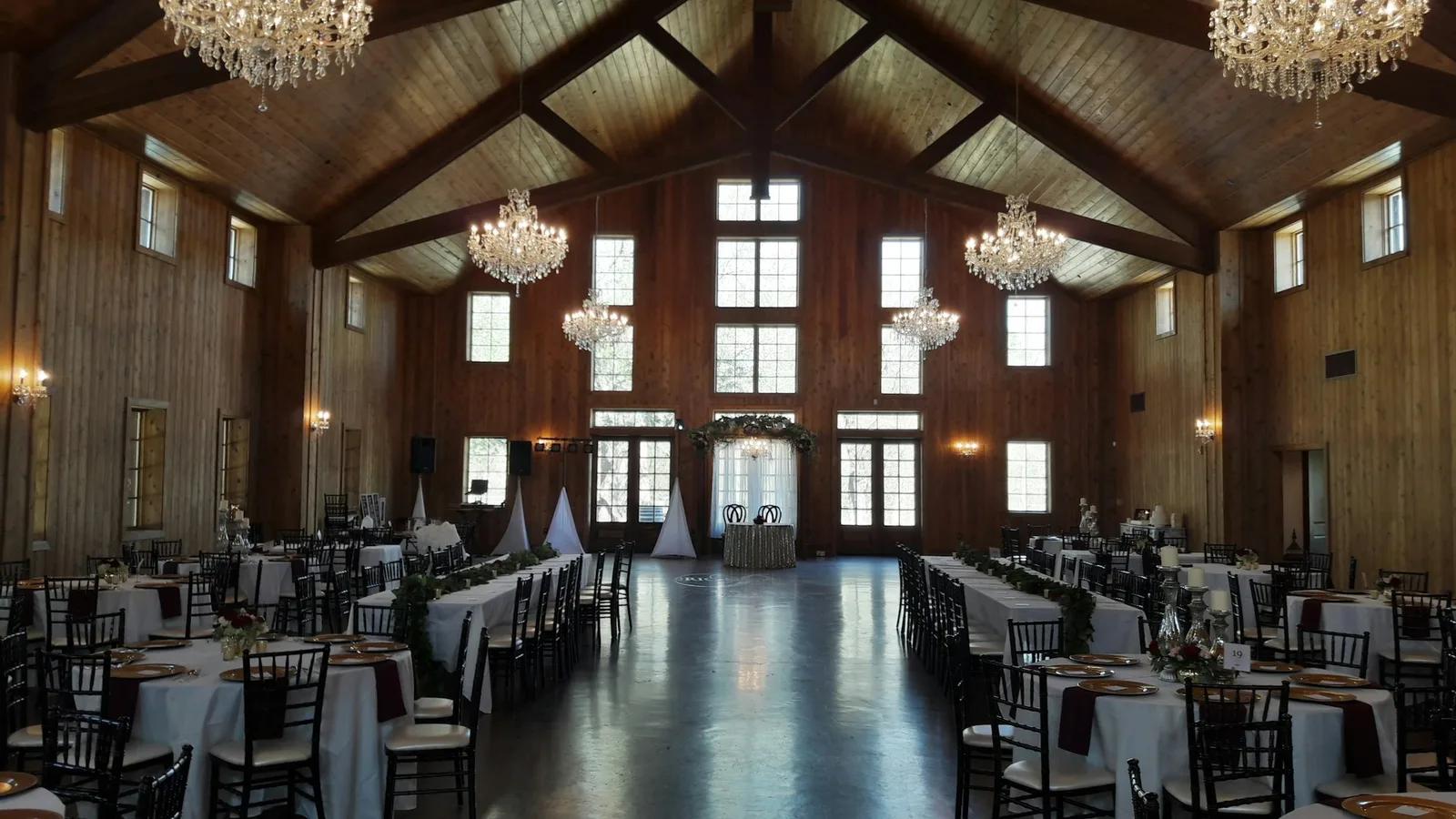
An empty timber-beamed reception hall with set tables on both sides and a dance floor in the middle
If the tables have to be moved for dancing, ask how long the change takes and where your guests wait meanwhile.
What does a wedding venue cost in 2026?
How venues charge
Hire only: a fee for the space; you bring the catering, and often the furniture.
Per guest: a menu or package per person, usually with drinks, staff and furniture; the room is included, or its hire is waived above a certain number of guests.
Hire plus per guest: both at once, which is common.
Minimum spend: a total you must reach in food and drink. Spend less and you pay the difference anyway.
Many venues price per person in bands — one figure for 50 to 79 guests, a lower one for 80 to 119 — so the price per head falls as the party grows. Most also publish a price list per year, and a wedding in 2027 may fall on a list that is not out yet. Ask whether the price you are quoted is fixed for your date.
Rough prices in euros
As a rough guide for 2026:
Hire alone, a Saturday in season: about €2,000–9,000. Castles, estates and city landmarks can pass €10,000.
A venue that cooks, food and drink together: about €80–180 per guest, more in big cities and resorts.
Quintas in Portugal and fincas in Spain: often €60–150 per guest for the menu, sometimes with a hire fee of €2,000–6,000 on top. Our guide to choosing a quinta goes into the Portuguese side.
The price moves with the region, the season, the weekday, your number of guests, how late you stay (overtime is often charged by the hour) and whether you have the place to yourselves.
On Eventadore every venue is in the search. With your date and number of guests, each card shows what that day costs, all in; without them, you see the venue's price range. The price is locked the moment you add a venue to your Planning, so nobody sends you a new price later — the venue only says whether your day is free.
The kitchen rule: own catering, a partner list or free choice
This question shapes your whole budget. A venue works in one of three ways:
Own kitchen only. The venue cooks, or its exclusive caterer does, and you choose from its menus. An outside caterer is not allowed, so the menu is part of the venue decision.
A partner list. You choose from caterers the venue knows and trusts.
Free choice. Any caterer you like — but check there is a kitchen at all, with power, water and cold storage, whether the caterer pays the venue a fee, and who cleans up.
Ask about drinks and the cake too: some venues charge corkage if you bring your own wine, or a fee for cutting a cake from an outside baker. Never book a caterer before the venue has confirmed it accepts them. Our wedding catering guide covers menus, drinks and prices per person.
Venues on Eventadore say how catering works at their venue when they register, and a venue with its own kitchen lists at least one menu.
Curfew, music limits and the neighbours
Every venue has an end time, and many have two: one for music outside, one for the party indoors. Ask:
Until when can we stay, and when must the last guest leave?
When does music have to stop outside, and inside?
Is there a sound limiter — a device that cuts the power when the music passes a set volume?
What does an extra hour cost?
These limits often come from the law, not from the venue. In Germany, night-time rest under state law generally begins at 22:00, which is why outdoor music at many venues ends then and the party moves inside. In Portugal, noisy activities near homes need a special noise licence (licença especial de ruído) from the municipality on weekday evenings after 20:00 and at any hour at weekends and on public holidays — DECO PROteste explains the rule. Rules differ from town to town and can change, so have the venue's limits written into your contract, and tell your band before they quote.
Rain plan, rooms, getting there and accessibility
The rain plan
Where does each part of the day go if it rains: the ceremony, the drinks, the dinner? Does the indoor space seat everyone, or is plan B a tent that costs extra? Who decides, and by when? Ask for photos of the rain set-up at a real wedding.
Rooms for your guests
How many rooms are there on site or close by, and must you book them all? Is there a room to get ready in, and when is check-out the morning after?
Getting there and home
Count the parking spaces against your guests' cars. Will a taxi come out to the countryside at one in the morning, or do you need a shuttle bus? Ask where suppliers' vans unload.
Accessibility
Is there a step-free way from the car park to the seats and the toilets, an accessible toilet, a lift, light on the paths at night? Gravel, lawns and old stone stairs are lovely in photos and hard for grandparents, wheelchairs and prams.
What's included, and what isn't
Two quotes compare only when you know what each leaves out. Go through this list with every venue:
Tables, chairs, linen, crockery, glassware and cutlery.
Staff: waiters, bar staff and a coordinator on the day.
Set-up and clear-down: when you and your suppliers can get in, and when everything must be out.
Cleaning, rubbish, cloakroom and security.
Sound system, a microphone for speeches, lighting, heating or air conditioning, and enough power for the band.
Exclusivity: are you the only wedding that day, and will hotel guests or the public be in the garden?
Decoration rules: candles, confetti, nails in beams, sparklers.
A ceremony on site: legal or symbolic? In Germany, for example, the registry office marries couples only in its own rooms or in places it has approved; elsewhere the ceremony is symbolic. See getting married in Germany.
A damage deposit, and whether you need event insurance.
Questions to ask a wedding venue before you sign
Is our date free, and how long will you hold it while we decide?
How many guests do you seat for dinner with a dance floor, and what is the legal maximum?
What exactly is included, and what is extra?
How do you charge — hire, per guest, minimum spend — and is the price fixed for our date?
Do you cook yourselves, work from a partner list, or allow any caterer? Is there corkage or a cake fee?
When does the music stop outside and inside, and what does an extra hour cost?
What is the rain plan, and who decides when to use it?
Are we the only wedding that day, and must we book your rooms?
When is our final number due, and can it still go down after that?
How much is due when we sign, when is the rest due, and what happens to it if we cancel — or you do?
Who is our contact on the day, and who exactly is the contract with?
You can message any venue from its profile on Eventadore before you visit, and keep what each one says in your Notes. When you reserve, the checkout names who you contract with: the legal name, town and country, and whether they offer as a business or a private person. For your other suppliers, see questions to ask wedding suppliers.
A worked example: two venues for 90 guests
Lena and Jonas are planning for 90 guests on a Saturday in June and have two venues left. The figures are made up; the pattern is a common one.
Venue A, a barn with free choice of caterer:
Hire for the day: €4,500
Caterer, €95 per guest with staff: €8,550
Drinks, €35 per guest: €3,150
Linen and glassware hire: €600
Shuttle bus back to town (no rooms on site): €800
Total: €17,600. Music outside until 22:00, inside until 2:00.
Venue B, a country hotel with its own kitchen only:
Package, €145 per guest — menu, drinks, staff and linen: €13,050
Room hire waived from 80 adults (otherwise €2,000): €0
One extra hour after the 1:00 end, at €400 an hour: €400
Total: €13,450. Thirty rooms on site, so no shuttle.
Venue B looked dearer per head and comes out €4,150 cheaper. Now suppose the list shrinks to 70. Venue B becomes €10,150 + €2,000 hire + €400 = €12,550; Venue A becomes €4,500 + €9,100 + €600 + €800 = €15,000. B is still cheaper, but its minimum now costs €2,000. Compare totals for your own number, including what each venue leaves out. Our wedding budget breakdown shows how the venue fits the rest of the money.
Frequently asked questions
How far in advance should we book a wedding venue?
For a Saturday between May and September at a popular venue, often 12 to 18 months ahead; weekdays and the months from October to April usually leave more room. Book the venue before anyone else, because your date and place decide which suppliers are free and in reach — see the wedding planning checklist.
How many venues should we visit?
Two to four, after shortlisting online by capacity, price and the kitchen rule. Go at the time of day of your wedding, see the rain plan, and write the answers down on the spot.
What is a minimum spend at a wedding venue?
The least you must spend on food and drink, or on the whole booking. If your bill comes in lower — because fewer guests come, say — you pay the difference anyway. Get it in writing, with what counts towards it.
Can we bring our own caterer to any venue?
No. A venue with its own kitchen usually allows no outside caterer, and some allow only caterers from their partner list. Only a venue with free choice lets you bring anyone, and even then check the kitchen, any fee and the cleaning.
What should the venue contract say?
Date and times, rooms, guest number and its deadline, what is included, the price and when each part is paid, the music end time, the rain plan, cancellation terms on both sides, and the exact name of who you contract with.