Qué poner en la web de la boda: las secciones que leen los invitados, textos listos para usar, qué dejar fuera, quién puede verla y una web en varios idiomas.
El equipo de Eventadore11 min de lecturaActualizado el 26 de octubre de 2026
Put on your wedding website everything a guest would otherwise have to ask you: the date, each place with its full address and start time, the schedule, how to get there and where to stay, the dress code, how and by when to reply, what you would like as a gift, and a short FAQ. Leave off what a stranger could misuse or a guest could take the wrong way: your home address, the days your home stands empty, the guest list, bank details in plain view, and who is invited to which part of the day.
What to put on a wedding website: the sections guests read
Guests arrive with a question, usually on their phone. Order the sections by what they need, not by how you would tell your story:
The day and the places — the date, full addresses, when to arrive.
The schedule — when it starts, when people eat, when it ends.
Getting there — trains, parking, shuttles.
Where to stay — two or three places at different prices.
Dress code — the term, plus one plain sentence.
Replies — the reply date and what you need to know.
Gifts — what you would like, said once and kindly.
Questions and answers — children, parking, rain, accessibility.
A welcome and your story — short; nobody comes back for it.
Photos afterwards — where guests send theirs.
If you build your free wedding website on Eventadore, you pick one of twelve designs and write each section once, in your own language; move a section with the arrows or hide it with its tickbox. Three fill themselves from your Planning: The day shows the events of your guest list and the times of your running order, The venue your booked venue with its address, and Our team the suppliers you booked, each linked to their profile.
The day, the places and the schedule
Every guest opens this section, some of them three times.
Give the full address, not just the name. An estate's name means nothing to a taxi driver at 13:40. Add a map link and, if the entrance is hard to find, one line: "the second gate after the barn".
Separate arriving from starting. "The ceremony starts at 14:30 — please be seated by 14:15."
Explain the gap if the ceremony and the party are in two places: the drive, and what happens in between.
Say when it ends. Guests with babysitters and last trains plan around the last bus, not the first dance.
A worked example: Lena and Jonas marry on Saturday 12 June 2027 with 85 guests, ceremony in the garden, dinner in a barn on the same estate, hotels fifteen minutes away. Their schedule for guests:
Friday, 19:30 — Drinks at the hotel bar for anyone already in town; no need to reply.
Saturday, 14:00 — Arrive at the estate; the ceremony starts at 14:30.
15:15 — Drinks and cake on the terrace; group photo at 16:00.
18:00 — Dinner in the barn.
21:30 — The first dance, then the party.
23:30 and 01:15 — Shuttle buses back to the hotels.
What they left out: hair and makeup at nine, the portraits at golden hour, the order of the speeches. That is the running order for the suppliers; this sample wedding day timeline shows the detailed version.
Getting there and where to stay
Travel is where a wedding website saves the most messages.
How to get there
The nearest station and airport, with the time from each to the venue.
Parking: where, how many places, whether it is free.
Shuttle times in both directions.
Taxis: in the countryside, book ahead; give one number that works there.
Where to stay
Two or three places at different prices, with the minutes to the venue.
If you have held a block of rooms, the name to quote and the date to book by.
For a wedding abroad, add the currency, whether cards are taken everywhere and how cool the evenings are. Marrying in Portugal? See getting married in Portugal.
Dress code, children and the questions guests are too polite to ask
Dress code: the term, then what it means
Dress-code words mean different things to different guests. Debrett's, the British etiquette publisher, calls "lounge suit" a misleadingly named code for business attire, yet many guests read it as relaxed. So write the term, then a sentence: "Black tie: dinner jackets, and long or cocktail-length dresses." Then add what the place means: grass under the ceremony chairs (block heels, not stilettos), a barn that cools at night (bring a layer), a church that expects covered shoulders.
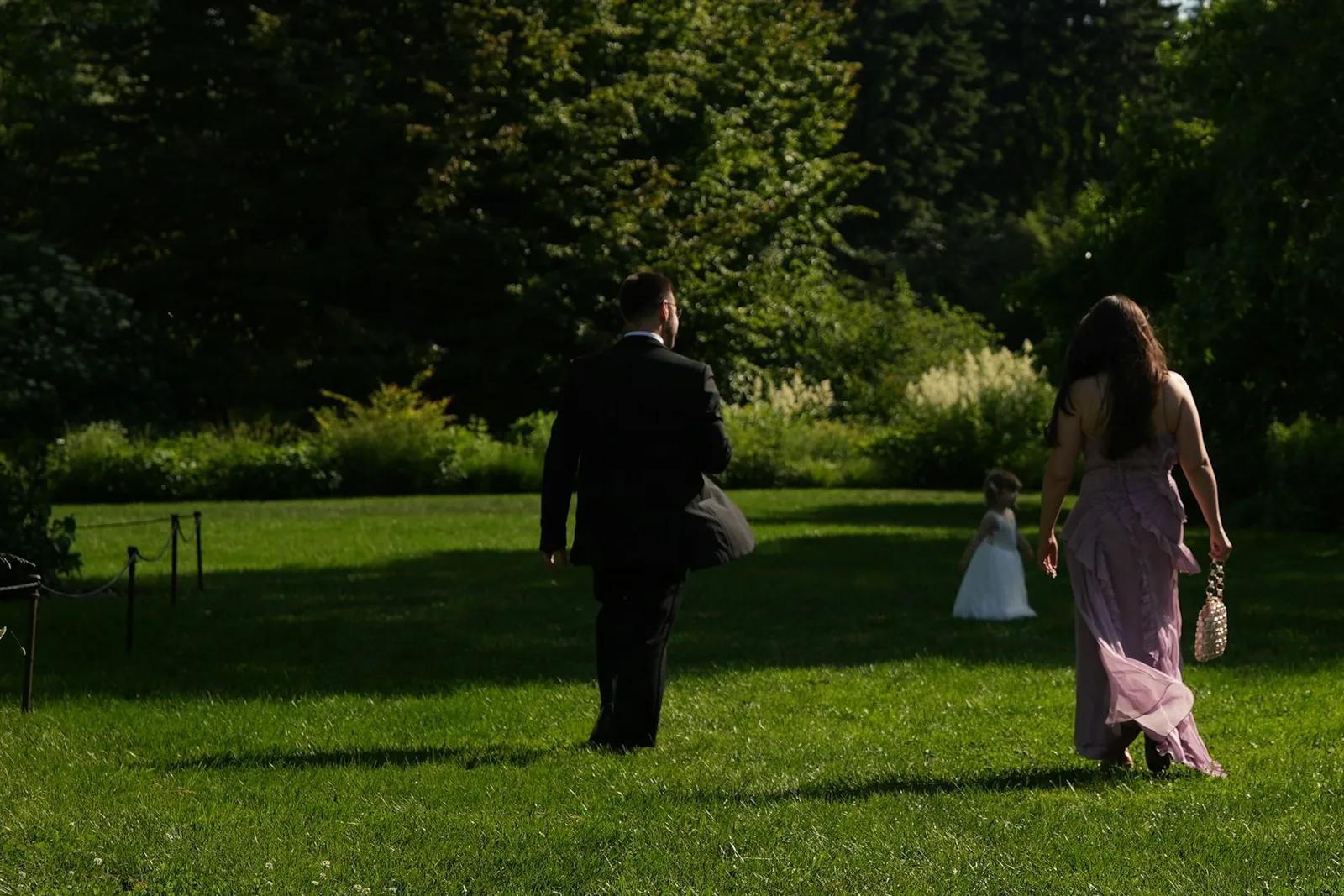
Two wedding guests in a dark suit and a long lilac dress, seen from behind, crossing a sunny lawn
Children and plus-ones
Who is invited is written on the invitation, by name; the website only confirms it. "We love your children, but the evening is for adults — they are very welcome at the ceremony and the drinks" is kinder than a rule in bold. Never let the website be where someone learns they have no plus-one. To settle those questions first, see how to make your guest list.
Your FAQ: five answers to borrow
Is there parking? Yes, free, beside the barn. The last 300 metres are gravel.
What if it rains? The ceremony moves into the barn; the times stay the same.
Can we take photos during the ceremony? Please keep phones away until we have said yes; our photographer will share everything.
Is the venue step-free? The barn and the toilets are; the garden path is gravel, and we keep seats at the front for anyone who needs them.
Who do we call on the day? Clara, Lena's sister. Her number is on your invitation.
Gifts: what to write and where your bank details go
Say it once, near the end: "Having you there is the gift. If you would like to give something, a contribution to our honeymoon would make us very happy." Then say how. In many families money is the usual wedding gift, and naming the way — a bank transfer, a card on the day, a wish list from a shop — saves guests guessing.
Never name an amount, or a figure per guest.
Keep your IBAN off any page that anyone can open or a search engine can read.
On an Eventadore site you add bank details under Bank transfer and any wish list or payment page under Wish lists and payment links. Guests see the bank details only after pressing Show details, so Google never reads them, and no money passes through the platform: guests pay you directly.
Replies: what to ask, and by when
The reply date: four to six weeks before the day, so the caterer and the venue get the final number by the date in their contract, often one to two weeks before. More on when to send save-the-dates and invitations.
One reply per household, naming each person, so nobody replies twice or forgets the children.
Who comes to which part, if some guests are invited to the ceremony only, or to the Friday drinks.
Food needs and allergies, as a free line rather than tick boxes nobody quite fits.
Extras that earn their place: a song for the dance floor, or the arrival day if you run shuttles.
Every extra question delays replies. The day after your reply date, chase the missing replies by phone. How replies land in your guest list is explained in the guide to your guest list and replies.
Privacy: what to leave off and who can see it
What to leave off your wedding website
Your home address, and, for the same reason you would not announce a holiday online, your honeymoon dates.
The guest list, and any name beyond yours and those of people who agreed to be on the page.
Who is invited to which part. Each household learns that from its own invitation.
Phone numbers. Put them on the invitation, or behind a password.
What it all costs, the exes, and the in-jokes half the guests will not get.
Photos of other people's children, unless their parents say yes.
Who can see it, and whether Google can find it
Keeping a site off Google is not the same as keeping it private: Google's own documentation says a page left out of its results can still be visited by anyone with the link, and that a password is what keeps strangers out.
In the Privacy tab of an Eventadore site you choose one of three:
Anyone with the link — guests reply by typing their name.
Anyone with the link and a password — six digits you print on your invitation.
Only invited guests — visitors type their name first, and only households on your guest list get in.
Show on Google is on from the start, so guests who search your names find you; it applies only to a site anyone with the link can see. To reply, a guest types their first and last name as they are on your guest list and presses Find me. Part of a name finds nothing, so nobody can browse your list.
One wedding website for guests in several languages
If half the room speaks another language, a site in one language leaves them out. Whatever tool you use, write so that a translation has nothing to guess:
Short sentences, one fact each.
Dates in full with the day, "Saturday 12 June 2027", never 12/06/27, which an American reads as December.
Times in the 24-hour clock, and addresses exactly as they appear on a map.
Amounts with their currency, such as €40 for the shuttle.
No puns or idioms; they rarely survive translation.
With Eventadore you write once, in your own language. Publishing translates your texts into the other seven languages the site speaks; each guest sees their own language first, marked as translated, with your original one tap away. When you change something, press Update site and only what changed is translated again.
When to launch your wedding website, and what happens after the day
With the save-the-dates, six to eight months before, or nine to twelve for a wedding abroad: the date, the town, where to stay, "invitation to follow".
With the invitations, about three months before: everything else, including the reply date.
In the last week: final times and the rain plan; tell guests directly about any real change.
After the day: a thank-you, and one place for everyone's photos.
The site's address or a QR code goes on the printed invitation, so it must never change; tell your stationery designer early so the layout leaves room for it.
The same builder makes the address from your two first names, the word "wedding" and a short code; once you publish, it never changes, and you can download a QR for print. The site also moves with the calendar by itself: Save the date until you set a reply date in your guest list, then The invitation with every section and replies, then Thank you & photos, where guests send theirs with Add your photos. It stays online for two years after the day.
Frequently asked questions
What should be on a wedding website?
The date, each place with its full address and start time, the schedule, travel and where to stay, the dress code, the reply date, your gift wishes and a short FAQ. Put your story after the practical sections.
When should you launch your wedding website?
With your save-the-dates, six to eight months before the day, or nine to twelve for a wedding abroad. The date, the place and where to stay are enough at first; add the rest with the invitations, about three months before.
Should a wedding website be password protected?
If it shows only the date, the town and the schedule, an open link is fine. Once it holds a hotel booking code, your wedding party's names or gift details, use a password or let in only invited guests. Hiding it from Google is not enough: anyone with the link can still open it.
Is it rude to put bank details on a wedding website?
No, if you say it kindly and once: in many families money is the usual gift, and guests are glad to know how to give it. Keep the details behind a click or a password, never on the open page, and never suggest an amount.
Do you still need paper invitations if you have a wedding website?
Not strictly, but a printed card still matters to many guests, older relatives above all. Let it carry what will not change, plus the website's address or QR code; everything that may change belongs on the website.