Wedding cake prices: styles, sizes and when to order
Wedding cake prices in 2026, per kilo and per slice: tiered, naked and fresh-flower styles, how many slices per guest, and when to order and taste.
The Eventadore team11 min readUpdated 26 October 2026
Translated from PortugueseRead the original
Wedding cake prices in Portugal in 2026 usually run from €200 to €800 for 100 guests: roughly €18 to €60 per kilo, or €2 to €8 per person, depending on the style, the decoration and the delivery. Allow one slice of 80 to 150 g per guest, book your cake six to nine months ahead for a summer Saturday, and do the tasting two to three months before the day.
Before you ask for quotes, check with your quinta (the country estate where you celebrate) whether the cake is already in the menu of the copo d'água, the wedding meal — in many it is. Then you do not pay for it separately, but it is still worth knowing what to ask for.
How much does a wedding cake cost? Price per kilo and per slice
In Portugal, most pastry shops (pastelarias) and cake designers sell wedding cake by the kilo. A rough guide for 2026, VAT included:
- A catalogue cake from a pastry shop: €18 to €25 per kg.
- Naked or semi-naked cake, with fruit or flowers: €22 to €35 per kg.
- A tiered cake made to your design, in sugar paste: €30 to €60 per kg. Handmade sugar flowers, hand painting and many tiers take it to the top.
- Delivery and set-up at the venue: often included close to the shop; further away, usually €20 to €60.
- Cake stand and knife: some include them, others hire them out.
To get the price per guest, multiply the price per kilo by the weight of a slice: at €30 per kg and 100 g per person, that is €3 a guest. For 100 guests, a simple pastry-shop cake comes to about €200; a designer cake with sugar flowers and delivery reaches €700 or €800.
What pushes the price up: the weight (in other words, the number of guests), the hours of decoration, the covering — sugar paste and ganache cost more than whipped cream — a different flavour in each tier, and the distance to the venue.
On Eventadore, every cake supplier is in the search for wedding cakes. Enter your date and number of guests and each card shows what that day costs, all in, travel included; without them, it shows a price range. To fit the cake into the whole budget, see how much a wedding costs in Portugal.
Wedding cake styles: how to choose
Classic tiered cake
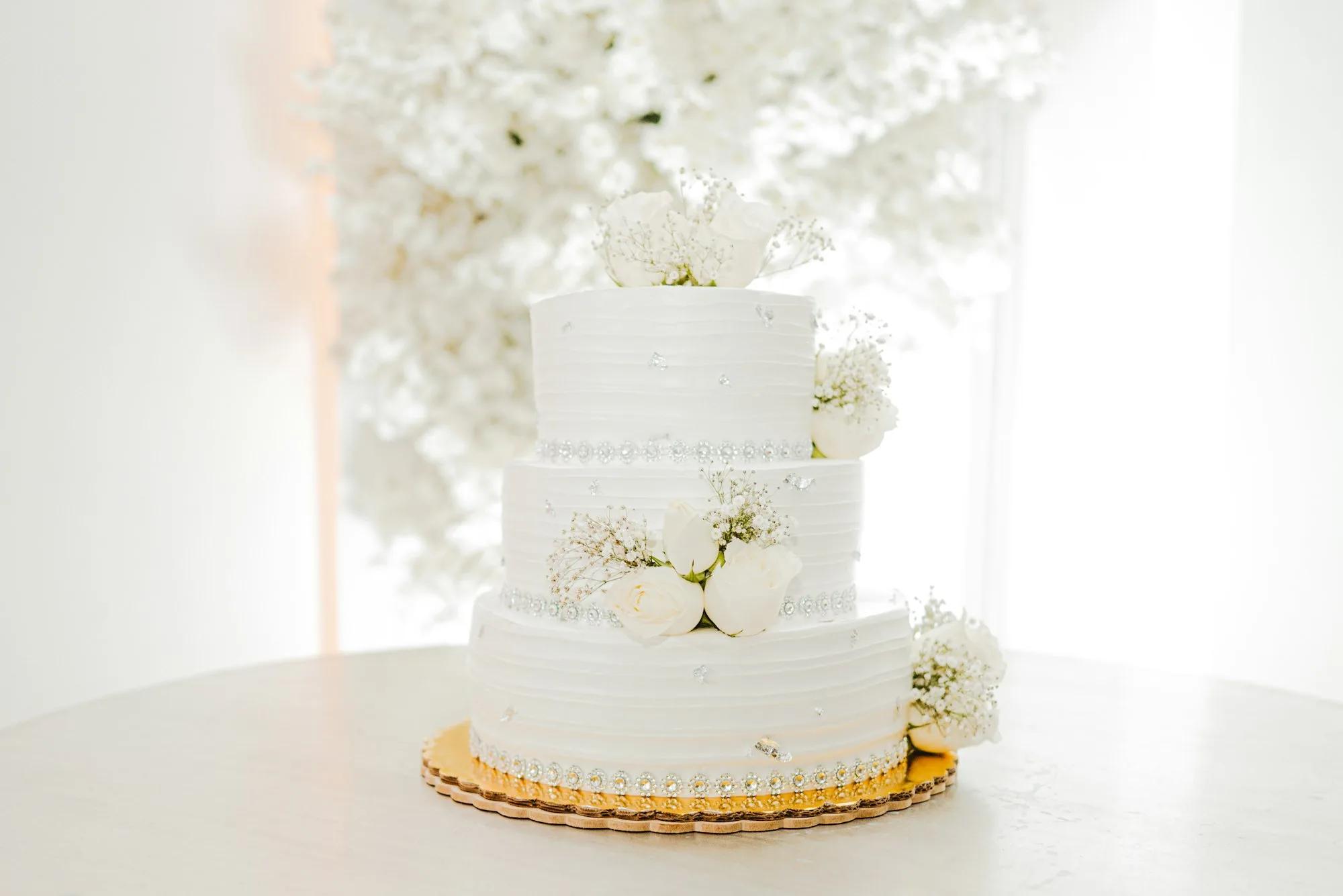
The white cake of three or four tiers, covered in sugar paste or royal icing, is still what many people picture as a wedding cake. Inside it is often a pão de ló (a light Portuguese sponge), with very Portuguese fillings — doce de ovos (a sweet egg-yolk cream), almond, chila (a jam made from fig-leaf gourd) — or lemon, chocolate and red berries. Sugar paste gives clean lines and holds up well when the cake is assembled; on the other hand, many guests leave it on the plate.
Naked and semi-naked cakes
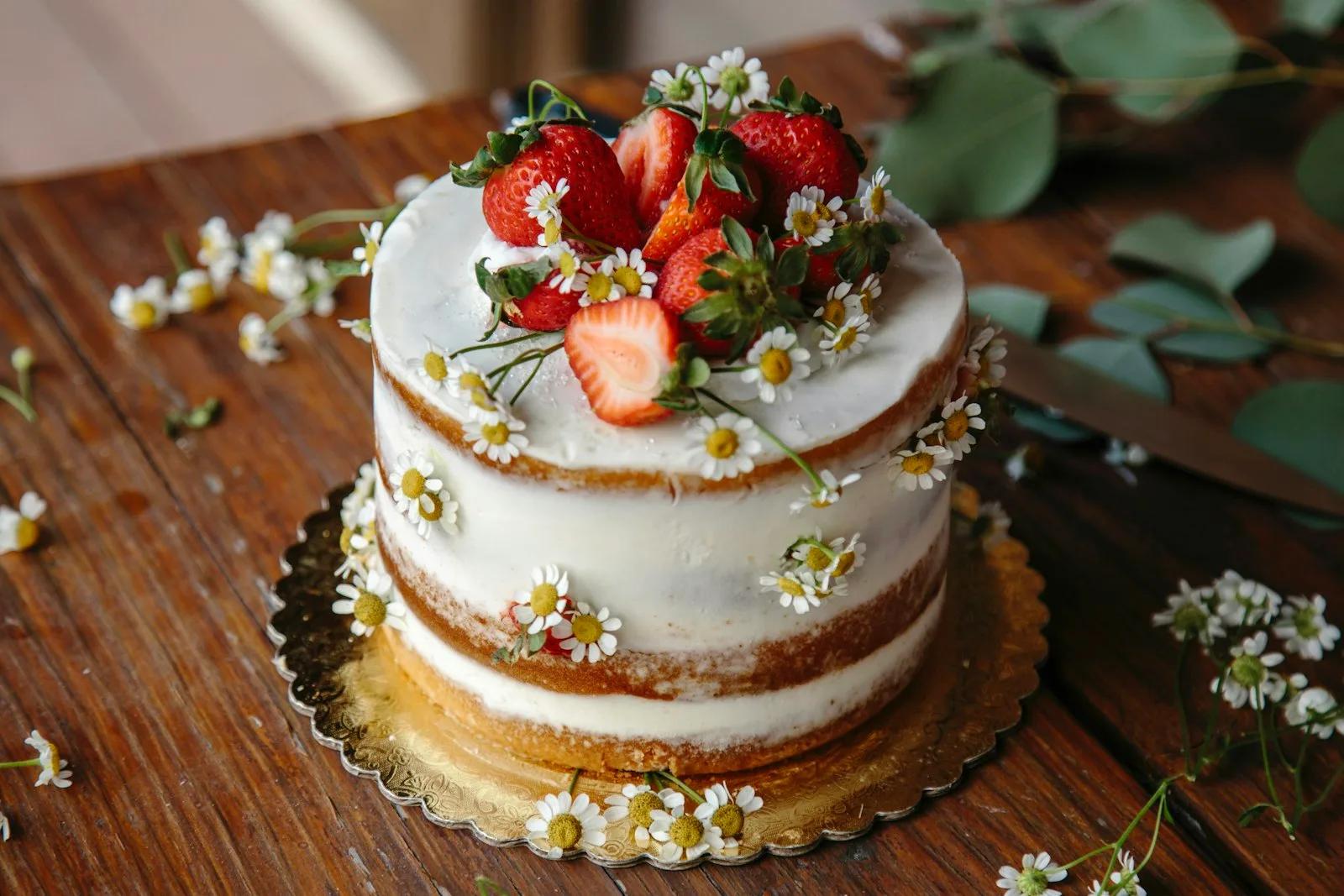
In a naked cake, the layers of sponge and filling are left on show, with no covering; in a semi-naked cake, a thin coat of cream lets the sponge show through. They suit country and outdoor weddings, are decorated with fruit in season and flowers, and usually cost less per kilo than a sugar-paste cake. Their weak point: they dry out and soften faster, so they should come out of the cold shortly before the cutting.
With fresh flowers
Roses, olive sprigs, wild flowers: real flowers tie the cake to the bouquet and the tables. Agree with the pastry shop who buys them and who places them — often it is the florist — and see further down which flowers can go on a cake.
A small cake and a dessert table
At many quintas, the dessert buffet is already generous: pão de ló, toucinho do céu (an almond and egg cake), rice pudding, ovos moles (sweet egg yolk from Aveiro), fruit. Then a small cake just for the cutting makes sense, or a dessert table with the cake in the middle — mini pastéis de nata, queijadas (small cheese tarts), macarons. Count three to four sweets per person; at €0.80 to €1.50 each, that is €2.40 to €6 a guest.
Dummy tiers
Polystyrene tiers, decorated like the rest of the cake, give height without adding kilos. You cut the real tier in front of your guests, and the pastry shop sends a plain kitchen cake with the same filling to be served in slices. The saving is mostly on the decoration, which is the most expensive part of a cake.
How many slices per guest? How much cake to order
The rule most people use is simple: 80 to 100 g per person when there is a dessert buffet, 120 to 150 g when the cake is the only dessert. For 100 guests, that is 8 to 15 kg. Count everyone, children included: not everybody eats cake, but it is better to have some left over than to run short.
As a guide, a round tier about 10 cm tall gives these thin slices of 80 to 100 g:
- 15 cm across: 12 slices
- 20 cm: 24 slices
- 25 cm: 38 slices
- 30 cm: 56 slices
Example: the cake for 100 guests
Inês and Tiago are marrying at a quinta in the Minho, with 100 guests and a dessert buffet in the menu. They want a three-tier sugar-paste cake with fresh flowers, and allow 100 g per person: they need 100 slices, about 10 kg.
- Display cake of three tiers, 15, 20 and 25 cm: 12 + 24 + 38 = 74 slices, about 7.4 kg at €35 per kg = €259
- Kitchen cake with the same filling and no sugar paste: 3 kg, about 30 slices, at €20 per kg = €60
- Fresh flowers for the cake, from the florist: €40
- Delivery and set-up at the quinta: €35
Total: €394 for 104 slices, or €3.94 per guest.
To have all 100 slices in the display cake, they would need tiers of 20, 25 and 30 cm: 24 + 38 + 56 = 118 slices, about 11.8 kg, or €413 for the cake alone. That is €94 more than the €319 of the display cake plus the kitchen cake, to serve the same people.
When to order your wedding cake, and when to taste
For a Saturday between May and October, this timeline tends to work:
- As soon as you have the venue: ask whether the cake is in the menu and whether they accept a cake from outside.
- 6 to 9 months before: book the cake designer. A designer cake takes many hours, and some take only a few per weekend. For a catalogue cake, two or three months are often enough.
- 2 to 3 months before: the tasting. Try two or three fillings, ask the weight of a slice, and look at photos of cakes they have made for outdoor weddings. Some tastings are free, others are paid, sometimes taken off the order.
- 1 month before: settle the design, the flavours, the flowers and the delivery time with the venue.
- 2 to 3 weeks before: give your final number of guests — the same one you give the caterer.
- In the week of the wedding: confirm who receives the cake at the venue, where it is kept and who cuts it.
On Eventadore, you can ask any supplier from their profile whether they do tastings, have a gluten-free option or deliver to your area; phone numbers and links stay hidden until a booking is paid. When you add a supplier to your Planning, the price is locked at that moment and nobody renegotiates it later: the supplier only says whether they are free. For everything else to ask, see the questions to ask wedding suppliers.
Cake included by the venue, or ordered separately?
When the cake comes with the menu, it is made by the quinta's kitchen or by a pastry shop they work with. You choose the design and flavours from what they offer; a taller cake or a designer cake is paid as the difference.
Before you order a cake from outside, ask the venue:
- whether they accept outside cakes, and whether they charge a fee to store, cut and serve one;
- where it is kept until the cutting — a fridge or a cool room — and what time it can arrive;
- who cuts and serves, and whether there are plates and forks for everyone;
- what their rules are for candles, cold sparklers or fireworks at the cutting.
Some quintas work only with their own kitchen or a closed list of suppliers, and that may include the cake. Read how to choose a quinta for your wedding and the wedding catering guide before you sign.
Heat, transport and fresh flowers: what can go wrong
The heat. In July and August, in the Alentejo and the Douro valley, temperatures above 35 °C are common. A buttercream cake softens on a day like that, and whipped cream and fresh cream should not spend hours out of the cold; sugar paste over ganache holds up better. Ask for the cake to stay in the kitchen or a cool room and come out only shortly before the cutting, in the shade and away from windows and the dance-floor lights.
Transport. A tiered cake travels in pieces and is assembled at the venue, on a firm, level table. Leave the delivery to whoever made it: if you collect it yourselves, whatever happens on the way is usually your problem.
Flowers. Florists' flowers are treated to last, not to be eaten. Ask for flowers grown without pesticides, with the stems wrapped in tape or in small tubes, and take them off before cutting. Some flowers are toxic and should not touch the cake, however pretty they are: lily of the valley, hydrangea, foxglove, daffodil, oleander. Untreated roses, chamomile, pansies, calendula and nasturtiums are safe choices. See the flowers of each season and the wedding florists.
The cake cutting in your wedding day timeline
At many Portuguese weddings, the cake is cut after dinner and the abertura do baile (the opening of the dancing), with a toast of espumante, Portuguese sparkling wine, and the ceia, a late-night supper, comes after. It is a good moment to bring everyone together again, but there are reasons to bring it forward:
- grandparents and children may already have left;
- the photographer's and the videographer's contracts may end at a set time: check they are still there;
- the cake spends less time out of the cold.
An example for an evening wedding: ceremony at 17:00, dinner at 19:30, opening of the dancing at 22:00, cake cutting and toast at 23:00, supper at half past midnight. Agree with the venue whether the slices go to the tables or to the buffet.
Put the time in your Running order, one of the free planning tools on Eventadore, and send it to the venue, the photographer and the DJ, who should have the music for the cutting ready. For the rest of the day, see the wedding day timeline, hour by hour.
Frequently asked questions
How much does a wedding cake for 100 people cost?
In 2026, usually €200 to €800: around €200 for a catalogue cake, about €400 for a three-tier sugar-paste cake with flowers and delivery, as in the example above, and over €700 for a designer cake with sugar flowers. If it comes with the quinta's menu, you do not pay for it separately.
How many kilos of cake do you need for 100 guests?
8 to 10 kg if there is a dessert buffet, and 12 to 15 kg if the cake is the only dessert — 80 to 150 g per person. Count everyone, children included.
How far ahead should you order a wedding cake?
For a Saturday from May to October with a cake designer, six to nine months ahead; a catalogue cake usually needs two to three months. The tasting is two to three months before the day, and the final number of guests goes in two to three weeks before.
Does a naked cake survive summer heat?
Yes, as long as it does not spend hours in the sun. Without a covering, the sponge dries and the filling softens faster than in a sugar-paste cake over ganache, so it should stay in a cool room until shortly before the cutting.
Can we bring a cake from outside to the venue?
It depends on the venue. Some accept it at no cost, others charge a fee per person to store, cut and serve it, and some quintas work only with their own kitchen or a list of suppliers. Ask before you order and get the answer in writing.
Are dummy tiers worth it?
Yes, when you want a tall cake for few guests, or when the dessert buffet is large and the cake is mostly there for the cutting. The slices come from a plain kitchen cake, which costs less per kilo.