Tamada wedding host: what a tamada does and what it costs
What is a tamada? The wedding host from the Georgian feast table: what a tamada does today, how they work with a DJ or band, and what one costs in 2026.
The Eventadore team11 min readUpdated 26 October 2026
A tamada is the wedding host who leads the evening: they give the toasts, hold the programme together, bring parents, witnesses and guests to the microphone at the right moment, and make sure two families end up at one table. The role comes from the Georgian feast table and, across the countries of the former Soviet Union, became the wedding host that many Russian-, Ukrainian- and Kazakh-speaking families also book in Germany. For one evening a tamada costs roughly €500 to €2,500 in 2026, and usually €1,900 to €4,500 together with a DJ.
A good tamada does not reel off a set programme: they ask about your families and shape the evening around you — even when half the guests speak no Russian.
Where the tamada comes from: the Georgian feast table
In Georgia the festive meal is called a supra, literally "tablecloth". Every supra has a tamada, who proposes the toasts and decides their order. At a meal at home this is often the host; for a wedding the family chooses, well in advance, a relative or friend known to be wise, eloquent and respected. They are not paid for it. It is an honour.
The toasts follow set themes, in an order that varies a little by region and family: peace and the occasion, the parents and the ancestors, those who have died, the children, the mothers, friendship. The tamada opens a theme, then a guest may take it further in their own words — this is called alaverdi. The toast to the dead is drunk standing, in silence and without clinking glasses; at the end everyone drinks to the tamada. Georgia's national tourism administration describes the supra as a ritual of sharing, where a toast sits between praise and plea, almost like a prayer.
In the old town of Tbilisi stands a bronze figure of a man with a drinking horn that everyone simply calls "Tamada"; it is modelled on a small ancient statuette from western Georgia. The role is very old — and it was always more than entertainment.
From the Georgian table to weddings in Germany
From Georgia the word spread through the countries of the former Soviet Union. In Russia, Ukraine, Belarus and Kazakhstan the tamada became the hired host of the wedding. They took over what the druzhka had done at the old Russian village wedding: the groom's friend who led the customs and mediated between the families. In Kazakh families the host is often also called the asaba.
With the families who came to Germany from these countries came the tamada. At German-Russian, Ukrainian or Kazakh weddings they are often the most important person after the couple. Traditionally the tamada was a man; today women often lead the evening too.
Because the word can sound like embarrassing party games, many prefer to call themselves a wedding host or MC. They mean the same thing: someone who leads the evening, not someone who takes it over.
What does a tamada do at a wedding?
A tamada is the director, the host and often the interpreter of the evening:
Welcome: they greet the guests, introduce the couple and the families, and say what the evening holds.
Toasts and speeches: they give toasts themselves, introduce the parents, witnesses and friends, and make sure nobody is forgotten and nobody speaks too long.
The rhythm: they coordinate with the kitchen, the service staff, the DJ and the photographer so that the courses, the first dance and the cake come at the right time.
Customs and entertainment: from the welcome with bread and salt to games and surprises from friends.
The mood: they notice when a table drifts off or an uncle will not give the microphone back, and sort it out kindly.
Family moments and customs
Many of the customs come from Russian, Ukrainian or Belarusian tradition. You decide with your families which of them you keep:
Bread and salt: the parents welcome the couple with the wedding loaf, the karavai, often on an embroidered cloth. Whoever bites off the bigger piece, so the joke goes, will rule the house.
"Gorko!": the guests shout "bitter!" and the couple kiss until it tastes sweet again — while everyone counts out loud.
Thanking the parents: a toast, a song or a dance, often the most moving moment of the evening.
Remembrance: a quiet moment for those who are no longer here — only if you want one.
The family hearth: the mothers pass the flame of their candles to the couple, who light a candle of their own with it.
The congratulations: the guests come forward one after another, say a few words and hand over their gift.
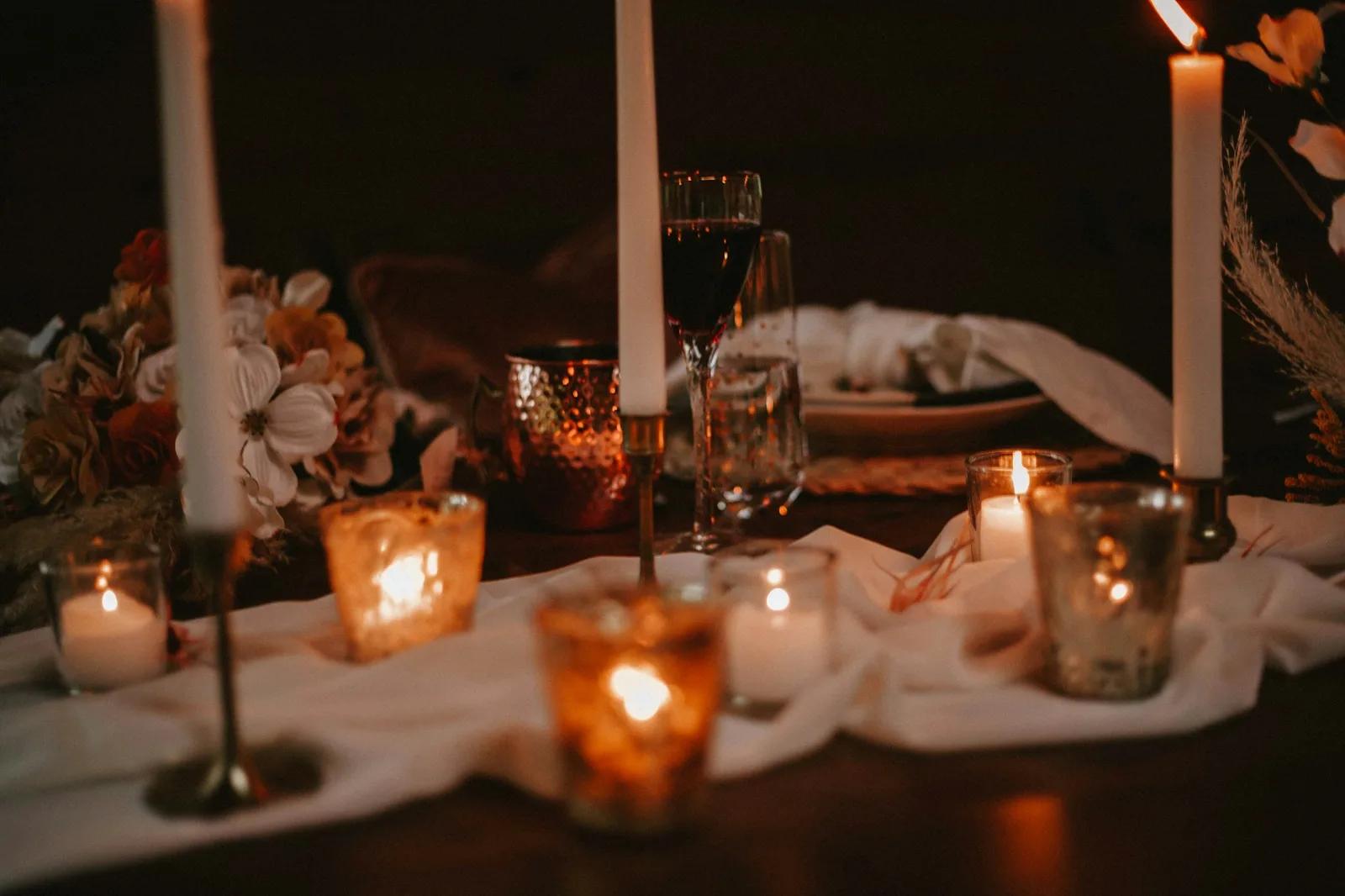
A wedding table laid for the evening with tall white candles, tea lights, flowers and a glass of red wine
At Kazakh weddings the betashar often belongs to the evening, the unveiling of the bride with a song; at Georgian ones the tamada remains above all the master of the toasts. A good host asks what your families know instead of selling you a standard programme.
Games: yes, but yours
For some guests games are part of it; others wince at the word "tamada" for exactly that reason. Decide for yourselves what happens: two or three short games that every generation can join are usually enough — a quiz about the couple, say, or the stolen bridal shoe the groom has to buy back. Nobody should be pulled to the front against their will or made to look foolish. And nobody has to drink at every toast: a glass of water counts just the same, and a good tamada says so out loud.
Hosting in two languages
When one family speaks Russian and the other German, a bilingual tamada is often the real reason for the booking. Done well, it does not mean translating every sentence: an experienced host switches language, sums up speeches briefly in the other one, and picks jokes that work in both. Grandma understands the best man's speech, and the colleagues from the office do not feel like guests at someone else's party. Ask for a recording where you can hear it.
An evening with a tamada: a sample schedule
Lena and Jonas are marrying with 120 guests, the registry office at midday and the party in a hall. Lena's family came to Germany from Kazakhstan; Jonas's family speaks only German.
17:00 The parents welcome the couple with bread and salt, the tamada greets everyone in both languages, drinks reception.
18:00 The couple enter the hall, first toast, words from the parents on both sides.
18:30 Starters; the tamada introduces the families.
19:30 Main course, then the witnesses' speeches.
20:30 First dance and the first round of dancing.
21:15 Congratulations, table by table at the microphone.
22:15 Family moment: thanking the parents, the family hearth.
22:45 Two short games, then the dance floor.
23:30 Cake.
02:00 Last song.
With 120 guests, allow 45 to 60 minutes for the congratulations; many tamadas split them into two rounds. Plan the whole day with the wedding day timeline, hour by hour, and keep it in your Planning in the Running order tool.
A tamada with a DJ or a band
Every announcement, every game and every family moment needs a musical cue. That is why many tamadas work as a fixed duo with a DJ who knows their routines; as a package it is often cheaper than two separate bookings. If you already have a DJ for your wedding, that works just as well. Then agree:
who brings the microphones and the sound system;
which music plays for which moment, as a list with times;
who makes the announcements, so they do not both talk at once;
a call together one to two weeks before.
A tamada fits a band especially well: the band's breaks are exactly the time for speeches, congratulations and games. How to choose is in DJ or live band? You will find wedding DJs and live bands in the search.
What does a tamada cost?
Rough guide prices for Germany in 2026, for an evening of about 6 to 10 hours:
Tamada alone, one language, little experience: €500 to €1,000.
Experienced tamada, bilingual, with a concept, planning meetings and props: €1,200 to €2,500.
Much sought-after hosts on a Saturday in the season: €3,000 and more.
Tamada and DJ as a duo, with sound and lighting: €1,900 to €4,500.
Tamada with a live band: around €4,500 to €7,000.
Each extra hour: often €150 to €400, nearer the top for a duo.
What moves the price: the day (a Saturday between May and September is the most expensive), the hours, the languages, experience, travel and equipment. Ask whether planning meetings and a written programme are included, and whether the price includes VAT. How it fits your budget is in how much does a wedding cost in Germany?
Worked example: tamada and DJ on a Saturday in August
Lena and Jonas book a bilingual duo for 9 hours, from 17:00 to 02:00, with sound, lighting and two planning meetings:
Duo package, 9 hours: €3,000
Travel: 90 km, the first 50 km included, then €0.70 per km, 80 km there and back: €56
That makes €3,056 planned. If they party until 04:00, two hours at €300 each are added: €3,656. They set aside €3,700 and order two supplier meals from the caterer.
On Eventadore the card already does this sum: with your date and number of guests, every host in the search for hosts shows what your day costs with them, travel included; without a date you see a price range. As soon as you add someone to your Planning, the price is locked and never renegotiated — the tamada only says whether they are free.
How to brief your tamada
A tamada is only as good as what they know about you. Plan a long planning meeting two to three months before and a short one two weeks before the wedding. Bring:
Names and pronunciation of the couple, parents, grandparents, witnesses and siblings.
Who belongs to whom: step-parents, separated parents, the godmother from Almaty. A host who knows that Jonas's parents are divorced will not call them up together for a game.
Who speaks: every speech, in order, with its rough length.
What is off limits: exes, money, looks, plans for children — and politics, including anything that hurts between families from different countries right now.
Those who have died: whether you want a moment of remembrance, and in what words.
Customs, games, languages: what is in, what is out, and which speeches should be summed up.
Schedule and contacts for the venue and the caterer.
Ask for a written programme and read it together. Whatever makes you uncomfortable on paper will be worse in front of 120 guests.
How to find the right tamada
Date, hall and guest count first. For a Saturday in the season, ask 9 to 12 months ahead.
Search by language. Hosts list on their profile the languages they work in, and you can filter by them in the search.
Watch whole evenings, not showreels. Ask for longer recordings of real weddings where you can hear how someone introduces speeches and switches language.
Read reviews from couples. On Eventadore only couples who booked and whose wedding has already happened can leave a review; nobody can buy a higher place.
Have a conversation. Do they ask about your families — or only talk about their games?
Ask them: Will you host it yourself? How many hours are included? Do you work with your own DJ? Who comes if you are ill? More are in the questions to ask wedding suppliers.
You can message any host straight from their profile; phone numbers and links stay hidden until a booking is paid. When you reserve, a booking fee is held on your card and only charged when the tamada says yes — within 72 hours if the wedding is more than two weeks away. The fee is already inside the price, and you pay the deposit and the rest to them directly: how paying works.
Frequently asked questions about a tamada
What is a tamada?
The host who leads a celebration: they give the toasts, introduce the speeches, guide the customs and hold the evening together. The role comes from the Georgian feast table, the supra; at many weddings in Germany a tamada is now a hired host.
Is a tamada the same as a wedding MC?
Almost. A tamada also knows the customs of Russian-, Ukrainian- or Kazakh-speaking families, brings toasts and family moments, and often hosts in two languages. In Georgia itself the tamada is usually a relative or friend who is not paid.
How much does a tamada cost for a wedding?
As a rough guide for 2026, around €500 to €2,500 for an evening, more for much sought-after bilingual hosts on summer Saturdays. With a DJ, packages are usually €1,900 to €4,500, and each extra hour €150 to €400.
How early should we book a tamada?
As soon as the date and the venue are set. For a Saturday between May and September, 9 to 12 months is a good lead time, because a tamada can only take one wedding a night. For Fridays, Sundays or winter, shorter notice often works.
Do we have to do the games and customs?
No. You decide what happens, and a good tamada follows that. Some couples want two short games, others only toasts, speeches and dancing.
Is a tamada worth it if only one family speaks Russian?
That is exactly when. A bilingual tamada makes sure both families understand the speeches and nobody feels like a spectator. Ask for a recording that shows they host freely in both languages.