Wedding DJ cost in Germany and how to choose the right one
Wedding DJ cost in Germany for 2026: realistic prices, what is included, overtime, equipment, song requests and how to choose a wedding DJ before you book.
The Eventadore team11 min readUpdated 26 October 2026
In Germany, a wedding DJ usually costs between €800 and €2,500 in 2026 for an evening with their own sound and lighting; full-time DJs who stay from the drinks reception to the last song often charge €1,800 to €3,000 or more. What moves the price above all is the playing time, the equipment, the travel and the day — a Saturday in June often costs more than a Friday in March — and knowing how to choose a wedding DJ matters as much as the figure.
You won't recognise the right DJ for your wedding by the lowest quote, but by the first conversation. A good wedding DJ asks about your guests — who dances, who knows nobody, which generations sit at the tables — and not just about your favourite songs. Here is what a quote should contain, how to compare prices and what to settle before you book.
A short slot, say the Standesamt (registry office) and a drinks reception, 2 to 3 hours: €300 to €600.
The party from the first dance, 5 to 6 hours, basic equipment, often a part-time DJ: €500 to €1,000.
A classic wedding evening with dinner and party, 6 to 8 hours, lighting and sound: €1,000 to €2,000.
The whole day from the ceremony until the last guest leaves, with hosting and more equipment: €1,800 to €3,000 and more.
Each extra hour: usually €80 to €200.
DJs who charge by the hour come in at roughly €100 to €220, often with a minimum number of hours. It gets more expensive on Saturdays from May to September, in big cities, with very experienced DJs and with a lot of guests, because a large hall needs more speakers. Fridays, Sundays and winter are cheaper. How the DJ fits into your overall budget is set out in our overview of what a wedding costs in Germany.
What a wedding DJ's price includes
A reputable quote shows what you are paying for. You should find these items in it — or see them explicitly excluded:
Playing time: fixed hours or open-ended. Ask when the clock starts: at set-up, at dinner or only at the first dance.
Sound: speakers to suit the room and the number of guests, plus at least one wireless microphone for speeches and announcements.
Lighting: light for the dance floor, often ambient lighting for the room as well.
Set-up and take-down: usually one to two hours before the start and after the last song.
Travel: often included up to a certain distance, then charged per kilometre; on long journeys an overnight stay is added.
The meeting beforehand: one or two, in person or by video, usually with a music questionnaire.
Background music for the drinks reception and dinner, quiet and right for the moment.
Cover: who comes if the DJ falls ill.
VAT: is the price gross or net? DJs who work as small businesses under § 19 UStG (the German VAT Act's small-business rule) charge no VAT.
On Eventadore, much of this is already in the figure you see: with your date and your number of guests, every card in the search for wedding DJs shows what that day costs with that DJ, travel included; without a date you see a price range. Travel is charged once per booking, never once per package.
Overtime: the most expensive unknown
Most celebrations run longer than planned. So allow for one or two hours of overtime from the start, and ask whether it is billed per hour begun or by the half hour, and whether the DJ can extend on the night if the venue stays open later. An open-ended flat rate pays off if your venue has no fixed finishing time and your guests like to dance until morning.
A worked example: 90 guests on a Saturday in June
Lena and Jonas are getting married with 90 guests in a barn 60 km from where their DJ lives. The celebrant-led ceremony is at 3 pm in the garden, dinner at 6:30 pm, the first dance around 9:30 pm. This is what a typical quote looks like:
Package with 6 hours of playing time from 8 pm to 2 am, lighting and sound, meeting beforehand: €1,400
Dinner music from 6:30 pm, 1.5 extra hours at €120 an hour: €180
Sound for the ceremony in the garden with a small system and two microphones: €250
Travel: 30 km each way included, then €0.80 per km, 60 km charged there and back: €48
That makes €1,878 as planned. If the two of them party until 4 am, two hours of overtime at €120 each are added: €2,118. So Lena and Jonas set aside €2,150 from the start — and every hour after 2 am is a conscious decision for them, not a surprise.
When does the DJ play? Ceremony, drinks reception, dinner and party
A wedding DJ does more than the party. Over the day they have four jobs, and each one needs something different:
Ceremony: music for the entrance, the exchange of rings and the exit, plus a microphone for whoever leads the ceremony. If the ceremony is in a different place from the celebration, a second small sound system is needed. If you would rather have live music for it, you will find singers and musicians for the ceremony.
Drinks reception: quiet background music so that your guests can talk.
Dinner: calm music between the courses, the microphone for speeches, and agreeing with the caterer when each course comes out.
Party: the first dance, then the dance floor — with breaks for the cake, the midnight snack or the bouquet toss.
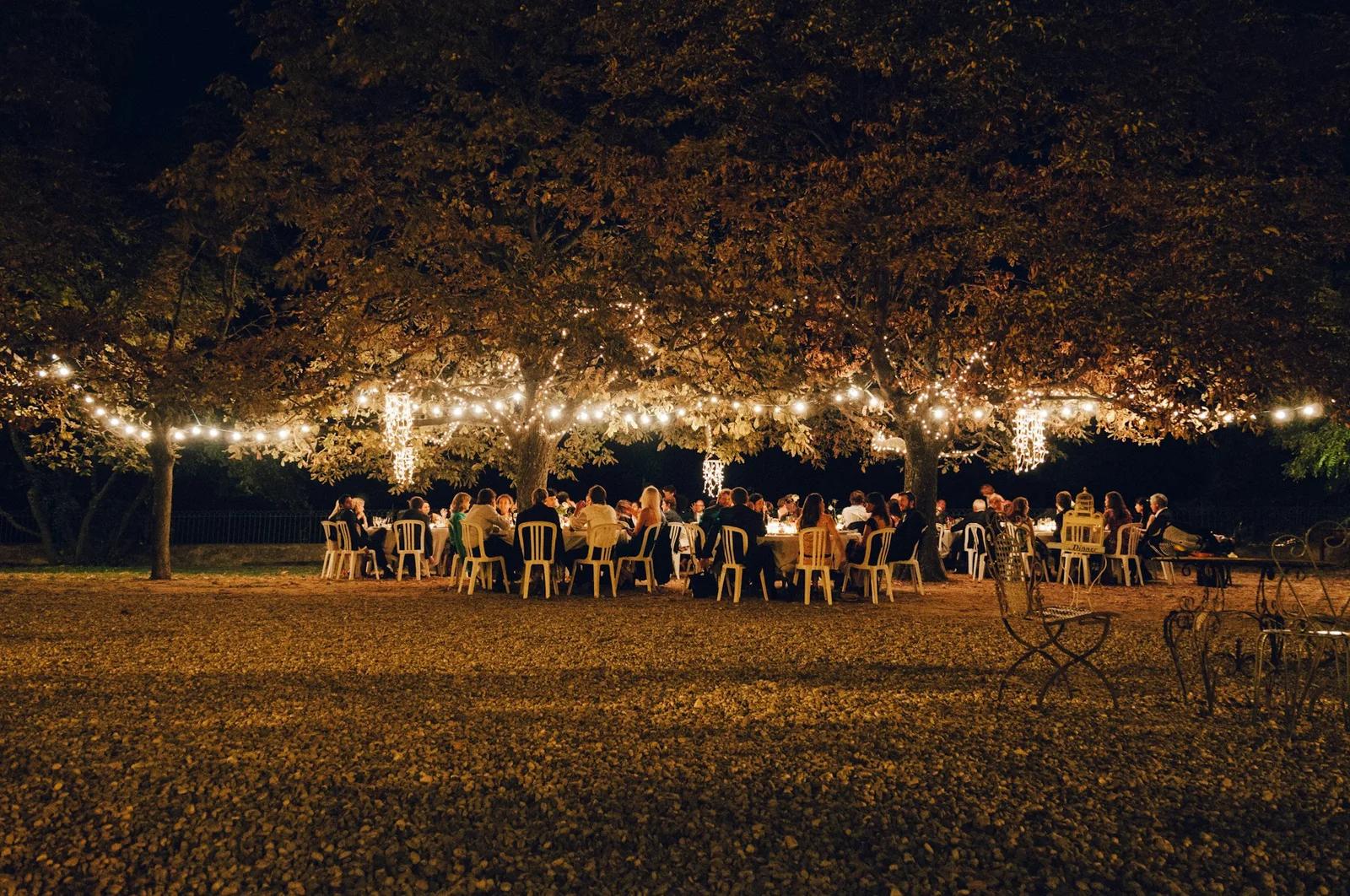
Wedding guests sitting at long tables under trees strung with fairy lights in the evening
Give your DJ a schedule with times, the names of your witnesses and a list of every speech and programme item. A wedding day timeline, hour by hour helps with planning; in your Planning you keep it in the Running order tool, which you both see on every device. At weddings with Russian-speaking or Georgian families, a tamada, the traditional host and toastmaster, often leads the evening with the DJ playing to their cues — in that case, agree beforehand who makes which announcement.
Song requests and the do-not-play list
A good DJ doesn't need a playlist of 200 songs, just a direction. What works:
The fixed songs: entrance, exit, first dance, cake and the last song. For the first dance, say whether it should be shortened.
10 to 20 must-plays: songs without which it wouldn't be your wedding.
A do-not-play list: no more than ten songs or genres you don't want to hear, and any party games you would rather skip.
Your crowd: ages, backgrounds, languages, who dances and who would rather listen. That is what the DJ builds the mood from, not your favourite playlist.
You can collect your guests' requests in advance. On your wedding website you can tick Ask guests for a song: every reply then brings a song for the dance floor, and under Song requests you see them all together — a list you simply pass on to your DJ. For requests on the night itself, agree whether the DJ takes them and whether they work them in as they see fit.
Equipment, volume and the venue
Before you book a DJ, ask your venue about its rules. Many have some, and the DJ needs to know them:
Time and volume: some venues cap the volume with a limiter or move the music indoors after a certain time. Outdoors, quiet hours start at 10 pm in many places.
Power: a normal socket is usually enough for the DJ and the lighting, ideally on its own circuit. Outdoors, the equipment needs a sheltered spot.
Space: allow about two by three metres for the DJ booth, close to the dance floor and not right next to the grandparents' table.
Smoke machines and smoke detectors: smoke and haze machines can set off fire alarm systems. Ask whether they are allowed.
Other equipment: a wedding photo booth also needs power and space, ideally near the dance floor.
And GEMA, Germany's music rights society? Under German copyright law, playing music only counts as public if it is meant for people who are not connected by personal relationships (§ 15 (3) UrhG, the German Copyright Act). A wedding with personally invited guests is therefore usually treated as a private celebration, for which no GEMA fee is due. There is no fixed number of guests for this. If your celebration is open to people you have not personally invited, ask GEMA beforehand.
How to choose a wedding DJ
Date and venue first, then the DJ. Without a date, nobody can say yes. For a Saturday between May and September, enquire 9 to 12 months ahead; for a Friday or a winter wedding, less is often enough.
Listen to weddings, not clubs. A club mix tells you little about how someone accompanies a dinner. DJs can show videos from YouTube and music from Spotify on their profile; ask for recordings from real weddings as well.
Read reviews from couples. On Eventadore, only couples who booked and whose wedding has already taken place leave reviews, and nobody can buy a higher place in the results.
Have a meeting first. Notice whether the DJ asks about your guests, the schedule and the venue — or only talks about their equipment.
Choose deliberately between a DJ and a band. What a band does differently, and when a combination pays off, is covered in DJ or live band for your wedding?
Questions to ask your DJ before you book
Is our date free, and will you be playing yourself or someone from your team?
How many hours are included, when do they start counting, and what does each extra hour cost?
What equipment will you bring for our number of guests and our venue, and how many wireless microphones?
Are travel, set-up and take-down and the meeting beforehand included in the price?
Can you also do the sound for the ceremony and the drinks reception in a different place?
Will you announce the programme items, or just play music?
How do you handle song requests from guests?
What happens if you fall ill?
How much is the deposit, when is the rest due, and what applies if the booking is cancelled?
Does the price include VAT, and are we signing the contract with a business or with a private person?
You will find more questions for every trade in questions to ask your wedding suppliers. You can put them to any DJ directly from their profile; phone numbers and links stay hidden in messages until a booking is paid.
Once you have decided, the price that applies is the one you see when you add the DJ to your Planning. Nobody renegotiates it later; the DJ only says whether they are free. When you reserve, a booking fee is held on your card and charged only when they say yes; it is already inside the price and never comes on top. If your day is more than two weeks away, they answer within 72 hours, and faster closer to the date; some DJs even accept at once. The checkout names who you are signing the contract with — name, town, country and whether a business or a private person — and you pay the deposit and the rest directly to the DJ. How it all works in detail is explained in how paying on Eventadore works.
Wedding DJ: frequently asked questions
How early should we book a wedding DJ?
As soon as your date and venue are fixed. For a Saturday in the wedding season from May to September, 9 to 12 months is a good lead time, because a DJ can only give each evening away once. For Fridays, Sundays or a winter wedding you can often still find someone at shorter notice.
How long does a DJ play at a wedding?
For the party alone, 5 to 6 hours is usual, from about 9 pm to 2 or 3 am. If the DJ also covers the drinks reception and dinner, it quickly becomes 8 to 10 hours. Check whether the time counts from set-up, from dinner or from the first dance.
Do we have to pay GEMA for the music at our wedding?
Usually not. A wedding with personally invited guests is generally not a public event, and then no GEMA fee is due. If your celebration is open to people you have not invited, ask GEMA beforehand, as the rules can change.
Does the DJ get something to eat?
On a long evening it is usual for the DJ to eat with you. Order a supplier meal from the caterer, plan for drinks and agree when they can eat — ideally during dinner, when quiet music is playing anyway.
Which is better for a wedding, a DJ or a band?
A DJ is usually cheaper, needs less space and plays every song in its original version. A band brings a live atmosphere, but takes breaks and has a fixed repertoire. You can combine the two, for example with live music for the ceremony and a DJ for the party.
Can the DJ also host the evening?
Many DJs announce the programme items: speeches, cake, first dance. If you want more — games, toasts, hosting in two languages — book someone specifically for that and agree how the DJ and the host work together.