Wedding DJ vs band comes down to this: a DJ plays any song in its original recording, without breaks, and usually costs €800 to €2,500 for an evening in 2026; a live band of four or five musicians brings the energy of people playing in the room, usually costs €2,000 to €5,000, and needs space, power and volume that your venue has to allow. Many couples take both — a musician for the ceremony, a band for the first hours of dancing and a DJ until the last song.
Taste matters less than you might think. What usually decides it is your budget, your venue's rules, how long your evening runs and who is on your guest list.
Wedding DJ vs band: the differences at a glance
Atmosphere. A band is a performance: a song everyone knows, played live, lifts a room like nothing else. A DJ follows the room and changes direction in half a minute when the floor thins.
Repertoire. A DJ can play anything ever recorded, in its original version. A band plays what it has rehearsed.
Breaks. A band plays in sets, usually two or three of 45 to 60 minutes. A DJ plays without stopping.
Space, power and volume. A DJ needs about 2 × 3 metres and one socket, and turns a knob; a four-piece band needs about 4 × 3 metres, at least two sockets, and drums that are loud by themselves.
Cost. A DJ often costs less than half of what a band costs for the same evening.
What does a wedding DJ or a live band cost?
Rough guide figures for 2026 across much of Europe; they vary between countries, and between cities and the countryside:
A DJ for the evening, with their own sound and lighting: €800 to €2,500; full-time DJs who stay from the drinks reception to the last song, €1,800 to €3,000 and more. For Germany, Sparkasse, a German savings bank, gives the same range.
A singer or a duo for the ceremony, a voice with guitar or piano: €400 to €1,500.
A saxophonist, violinist or percussionist playing over the DJ's tracks, two or three short sets: roughly €400 to €900 on top of the DJ.
A party band of four or five musicians, three sets: €2,000 to €5,000.
A larger band of six or more, with horns or several singers: €3,500 to €8,000; show bands with choreography, up to €10,000 and more.
What moves a band's price most is the number of people on stage: each extra musician adds roughly €300 to €600. Then come the hours (an extra set often costs €300 to €800), the day (Saturdays from May to September cost most), hotel rooms and whether a sound engineer is included. For a DJ, an extra hour is usually €80 to €200; see what a wedding DJ costs and how to choose one.
On Eventadore, every DJ, band and musician is in the search. With your date and number of guests, each card in the search for wedding bands or wedding DJs shows what that day costs with them, all in, travel included; without a date, you see a price range.
Atmosphere: what a band gives you, and what a DJ does better
A good live band is something to watch as well as to dance to. The singer can call the grandparents onto the floor by name, the band can stretch a chorus while everyone sings, and a horn section in full swing looks exactly like a celebration.
A DJ's strength is control. A skilled wedding DJ changes course the moment the floor thins, moves from swing to the nineties to a song from your family's home country in three tracks, and plays every song the way your guests know it. For a guest list spread across countries, languages and generations, that range is hard for any band to match.
So think about what your guests actually dance to. Soul, rock and pop classics: a band plays exactly that. Hip hop, electronic music or songs in several languages: a DJ covers them better.
Repertoire, the first dance and song requests
Ask a band for its full set list and tick what your guests would dance to. Most bands will learn a song or two for you, often the first dance, but that takes rehearsal: ask when you book, and expect it to cost extra, often a few hundred euros. A DJ simply needs the track.
For both, prepare the fixed moments (entrance, first dance, cake, last song), 10 to 20 must-plays, a short do-not-play list, and a word about your crowd: ages, languages, who dances.
On your wedding website, tick Ask guests for a song and every reply brings a song for the dance floor; Song requests gathers them in one list. Hand it to your DJ, or to your band: they pick the ones they can play, and the rest go into the playlist for their breaks.
Space, power and volume: ask your venue first
Often the venue decides before you do. Ask it these questions before you book any music, and pass the answers on in writing:
Stage space. About 4 × 3 metres for a four-piece band on a level floor, a metre wider for each extra musician; about 2 × 3 metres for a DJ.
Power. At least two sockets near the stage for a band, ideally on separate circuits; one for a DJ. In a marquee or a garden, ask where the power comes from at all.
A sound limiter. Many venues have one, often set between 90 and 100 dB. If the music stays above the limit for a few seconds, it cuts the power to the stage for up to a minute. A party band with acoustic drums often plays at 95 to 105 dB; a DJ is usually fine at about 90 dB.
A curfew. Outdoors, music often has to stop or move inside by 22:00 or 23:00; many venues end live music indoors at a fixed hour, too.
Set-up and access. A band needs one to two hours to load in, set up and soundcheck, ideally before the guests come in. Ask where the van can park.
If the venue's own system is too small, or the ceremony is in a garden far from the party, hire sound and lighting separately. More on what to ask a venue is in how to choose a wedding venue.
Breaks: how an evening with a band runs
Three sets of 45 to 60 minutes give you between two and a quarter and three hours of live music. Put the breaks where something else is happening anyway:
19:00 Dinner, with quiet music from the band's playlist or an acoustic duo from the band.
21:30 The first dance, played live, and straight into the first set.
22:15 Break: the cake, with music from a playlist.
22:45 Second set.
23:30 Break: the midnight snack.
00:00 Third set, until 00:45.
00:45 A DJ set until 02:00, by the band's technician or a DJ you booked.
Agree who plays music in the breaks, and order a meal for every musician and the technician. A wedding day timeline, hour by hour helps you fit the sets around speeches and dinner; in your Planning, the Running order keeps the times for both of you.
The combinations that work
You do not have to choose only one.
A musician for the ceremony and the drinks reception
A singer with a guitar, a pianist, a string duo or a quartet: live music for the walk down the aisle, the rings and the exit, then quiet sets while your guests have a drink. It costs a fraction of a band, at the moment when live music matters most. Ask whether they bring a small speaker and a microphone for whoever leads the ceremony. Find singers and musicians for the ceremony.
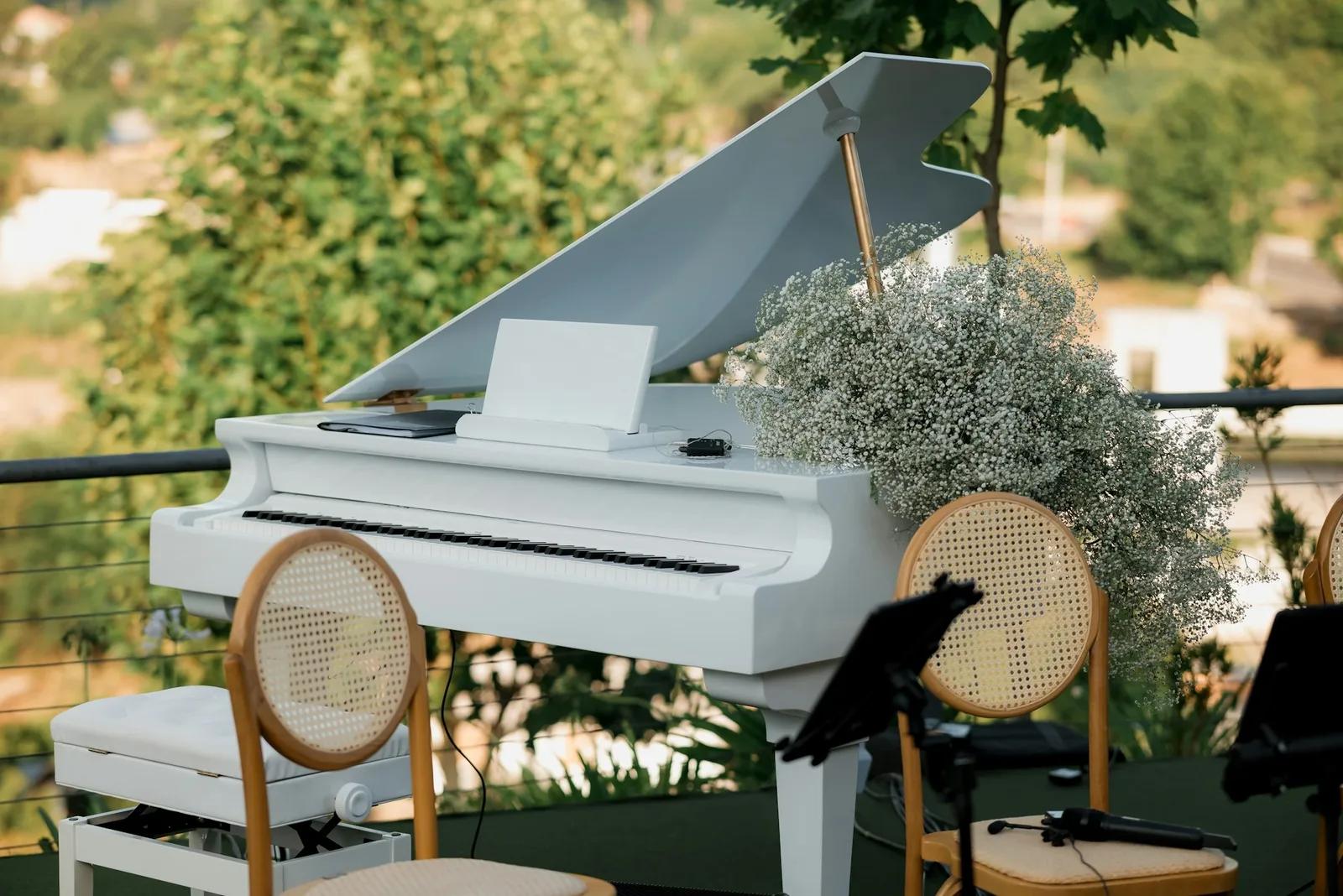
A white grand piano set up outdoors for a ceremony, with gypsophila, rattan chairs, music stands and a microphone
A DJ with a live musician
The DJ plays the tracks; a saxophonist, violinist or percussionist plays over them for two or three short sets in the busiest hours. Every song in its original version, a live moment on top, and no stage to build.
A band, then a DJ
The band plays the first hours, while everyone is still there; a DJ takes over until the end. Many bands offer a DJ set themselves. With a separate DJ, agree who brings the sound system, or you pay for two.
A worked example: two ways to fill one evening
Lena and Jonas are getting married on a Saturday in June with 100 guests: the ceremony at 15:00 in the garden, dinner at 18:30, dancing from 21:30 until 02:00.
Option A: a DJ all day, with a saxophone
DJ from the ceremony to 02:00, including the sound for the ceremony: €1,900
Saxophonist for two live sets on the dance floor: €600
Total: €2,500.
Option B: live music, then a DJ
Singer with guitar for the ceremony and the drinks reception: €500
Five-piece band, three sets from 21:30: €3,800
The band's own DJ set from 00:45 to 02:00: €300
Total: €4,600, plus meals for five musicians and a technician.
Then the venue answered their questions: a limiter at 92 dB in the barn, and live music only until midnight. That settled it — Option B would have meant a band playing quietly and stopping at its best moment. They chose Option A and added the singer for the ceremony: €3,000 in all.
How to choose: questions to answer, and to ask
First settle between you what you can spend on music in total, what your venue allows, and whether you would rather hear your song played live or exactly as you know it. Then ask the band or the DJ:
Who exactly plays on our day, and who stands in if someone is ill?
Can we hear a whole set from a real wedding, not only a showreel?
How many sets, how long, and what plays in the breaks?
Are the sound system, lighting, a sound engineer, travel and hotel rooms included?
What does an extra set or hour cost?
Do we sign the contract with a business or with a private person?
On Eventadore, bands, DJs and musicians can show videos from YouTube and music from Spotify on their profile, and you can put these questions to any of them from there; phone numbers and links stay hidden in messages until a booking is paid. Reviews come only from couples who booked and whose wedding has already happened. More questions are in questions to ask your wedding suppliers.
Once you have decided, the price is locked the moment you add the band or DJ to your Planning: nobody renegotiates it, they only say whether they are free. Reserving holds a booking fee on your card, charged only when they say yes and already inside the price; the deposit and the rest go to them directly, as how paying works explains.
DJ or band: frequently asked questions
Is a DJ or a band cheaper for a wedding?
A DJ, nearly always. As a rough guide for 2026, a DJ costs €800 to €2,500 for an evening and a band of four or five musicians €2,000 to €5,000, rising with every musician and extra set.
How long does a wedding band play?
Usually two or three sets of 45 to 60 minutes, with breaks of about half an hour: two and a quarter to three hours of live music. In the breaks, a playlist or a DJ takes over.
How much space does a wedding band need?
About 4 metres wide and 3 metres deep for four musicians, a metre wider for each extra one, with at least two sockets nearby. A DJ needs about 2 × 3 metres and one socket.
Can we have a band and a DJ at the same wedding?
Yes: the band plays the first hours and a DJ takes over until the end. Many bands offer a DJ set themselves; with a separate DJ, agree who brings the sound system.
What if our venue has a sound limiter?
Ask for the exact level and give it to the band before you book. From about 92 to 95 dB many bands can play, if more quietly than they like; below 90 dB, choose a DJ, an acoustic line-up or electronic drums.
How far ahead should we book a band or a DJ?
As soon as your date and venue are fixed. For a Saturday between May and September, 9 to 12 months ahead is a good lead time: each can play only one wedding an evening.