Symbolic wedding ceremony in Germany: costs and celebrants
A symbolic wedding ceremony in Germany, explained: what it means legally, how it runs, what a celebrant costs, and how to plan rituals, sound and a plan B.
The Eventadore team11 min readUpdated 26 October 2026
A symbolic wedding ceremony – in Germany called a freie Trauung – is a celebrant-led ceremony without a registrar and without a church: the celebrant tells your story, you make your own promises and you celebrate wherever suits you. It does not make you legally married; in Germany that still takes the Standesamt (registry office). A celebrant usually costs €900 to €2,000, and the whole ceremony with sound, music and flowers often €1,500 to €3,500.
What is a symbolic wedding ceremony – and what isn't it?
A symbolic ceremony is a personal celebration of your "I do". It follows no liturgy and no form: you decide the order, the length, the language, the music and the place. Religious elements are possible but not needed. That is why many couples choose it who don't belong to a church, have different faiths or come from two countries – and couples renewing their vows after many years.
What it is not: a marriage. Under § 1310 of the German Civil Code, a marriage in Germany comes about only when you declare before the registrar that you wish to marry each other. A symbolic ceremony changes nothing about your name, your taxes or inheritance.
Registry office and symbolic ceremony: in which order?
There is no fixed order. Three ways are common:
Standesamt a few days or weeks before, with a small group, and the big celebration with the symbolic ceremony later.
Both on the same day: the registry office in the morning, the symbolic ceremony in the afternoon – tight, but doable if the two places are close together.
Standesamt afterwards or somewhere else, for example if you celebrate abroad and marry at home.
The registry office marries couples in its own wedding room or at places the municipality has specifically designated – a meadow of your choice is usually not one of them. Which documents you need and how registering works is in our article on getting married in Germany. The rules can change; your registry office tells you what applies to you.
How a symbolic ceremony comes together: from first enquiry to "I do"
A good symbolic ceremony takes shape over months. Preparation typically looks like this:
9 to 12 months before: enquire and meet. Popular celebrants are booked early for summer Saturdays. A first conversation, often by video and usually free, shows whether the chemistry is right.
Book. Date, time, place, services and price go into the contract – along with what happens if the celebrant falls ill.
2 to 4 months before: the in-depth interview. Two to four hours just about you – more on that below.
4 to 8 weeks before: the running order. Celebrant, venue, musicians and photographer agree the entrance, the rituals and the timings.
One or two days before, if you like: the rehearsal. Who stands where, who walks in when, who hands over the rings.
The day. The celebrant arrives about an hour early, checks the sound and the space, and goes through the cues with your witnesses and the musicians.
The interview and the speech
The heart of a symbolic ceremony is the speech: your story, told for your guests. The interview covers how you met, what you love about each other, what you have come through together and what matters to you. Many celebrants send a questionnaire beforehand, some a separate one for each of you, so the speech holds a few surprises for you too.
Settle these early:
The tone: moving, funny, or both? A good speech makes the guests laugh and gives you a lump in your throat.
No-go topics: what must not come up – former partners, illness, family rows. Say so clearly.
Reading it first: some celebrants send the speech in advance, others deliberately keep it secret. Both are normal – ask how they work.
Language: with an international crowd, a bilingual celebrant switches between languages or sums up parts in the second one.
The speech itself usually lasts 15 to 25 minutes. Longer is rarely better.
The ceremony itself: a sample running order
A symbolic ceremony usually lasts 30 to 45 minutes, up to an hour with several rituals and live music. Here is how Lena and Jonas's afternoon could look, 80 guests, ceremony in the garden of their venue:
14:15 Guests arrive; water and lemonade wait in the shade.
14:45 Everyone takes their seats, quiet music plays.
15:00 The entrance: first Jonas with his mother, then Lena with her father.
15:05 The celebrant's welcome; the ring warming begins.
15:10 The speech: the couple's story, about 20 minutes.
15:30 Lena's sister reads a short text.
15:35 A ritual, for example a sand ceremony.
15:40 Vows, exchange of rings, kiss.
15:45 Recessional through a guard of honour of guests.
15:50 Drinks reception with congratulations – allow 30 to 45 minutes for 80 guests – then the group photo.
Between the registry office, couple portraits and the ceremony, allow 15 minutes too much buffer rather than too little. The whole day hour by hour is in our wedding day timeline. With an account on Eventadore, you keep the timings in the Running order of your Planning – for both of you, on every device.
Rituals for a symbolic ceremony
A ritual makes a moment visible. One or two are enough; more makes the ceremony long. These work well:
Ring warming: the rings travel through the rows in a little pouch, and every guest adds a good wish. Start it right at the beginning; with many guests, pass them along the front rows only.
Sand ceremony: you pour two colours of sand into one vessel. Outdoors it needs a steady table and some shelter from the wind.
Handfasting: your hands are bound with a ribbon, an old custom from the British Isles.
Wine box or letter ritual: you write each other letters, seal them in a box with a bottle of wine and open it on an anniversary, the fifth perhaps.
Candle ritual: with two candles you light a third together. Outdoors, only inside a lantern.
Involving your guests: a reading, a song, a blessing from the family, or a loud "yes" from everyone when asked whether they will stand by you.
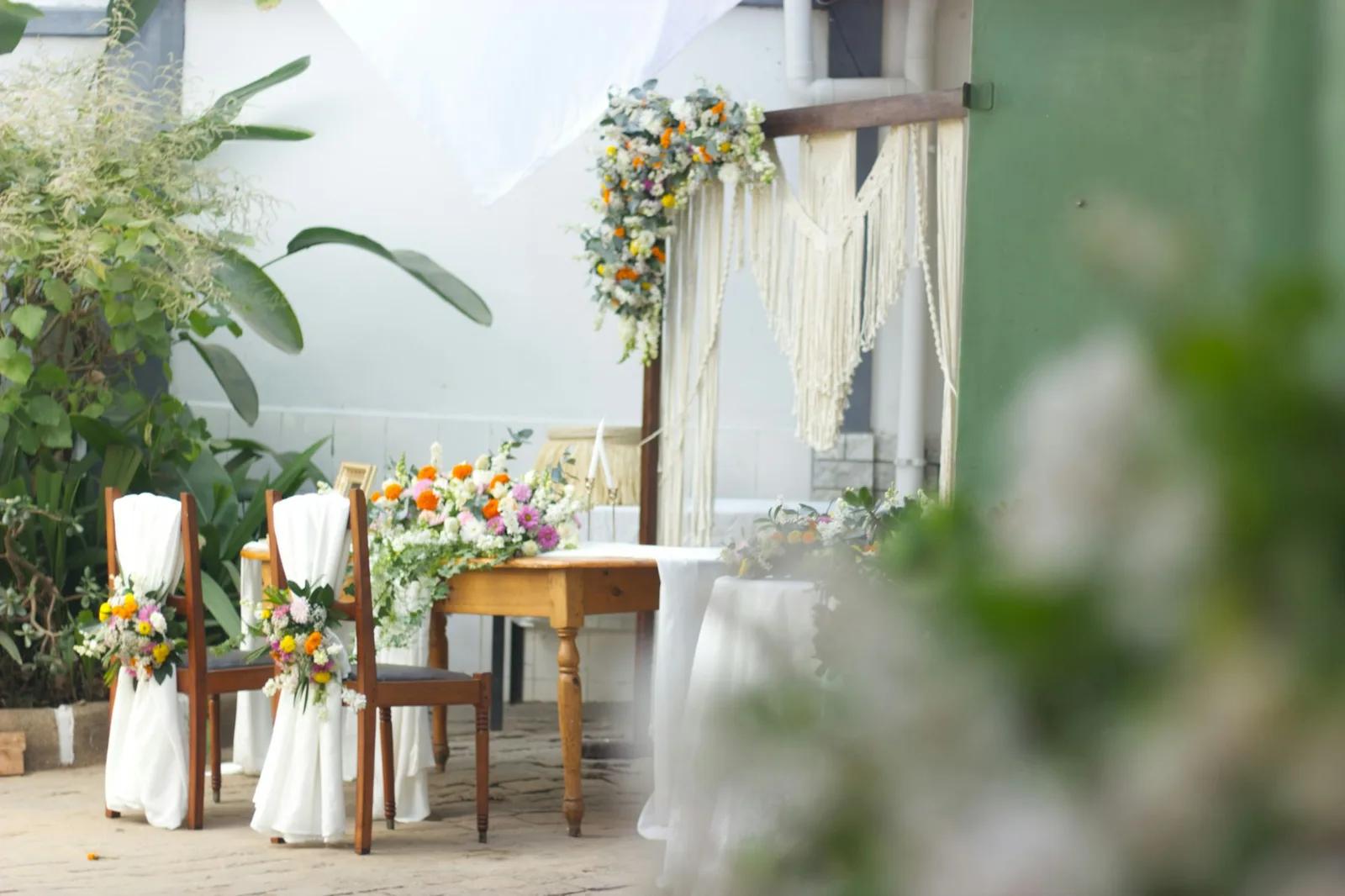
A ceremony table with flowers, two candles and two decorated chairs in front of a macramé backdrop
Writing your own vows
Your own vows are often the moment guests remember longest. One to two minutes each is enough, about 150 to 250 words. Agree the length beforehand, so one of you doesn't read a page while the other says three sentences. Read from a card, not your phone, and give the celebrant a copy – in case the card blows away.
Marrying outdoors: plan B, weather and place
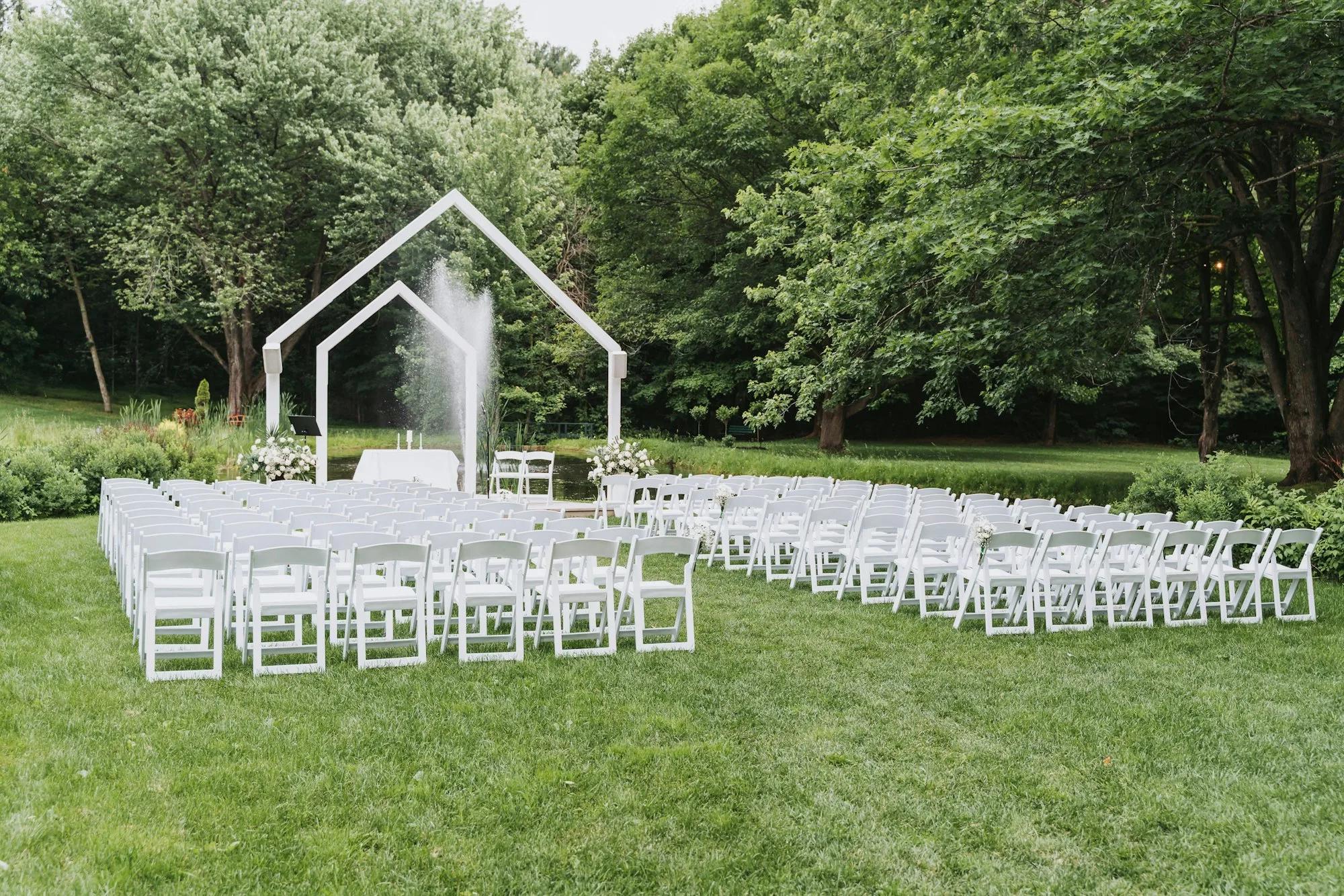
Most symbolic ceremonies take place outside, so every one needs a plan B. Good venues have a covered area or a room where the chairs can be set up in half an hour. Ask about it when you visit; the other questions are in our article on choosing a wedding venue.
Fix a decision time, say 10:00 on the morning of the wedding, and who decides. Then nobody is still debating at 14:00.
Think about the sun: at 15:00 in July, guests need shade and water. If you stand in the shade yourselves, your photographer will be pleased too – harsh midday sun makes difficult pictures.
Wind and rain hit microphones, candles, sand and notes. Ask whether the sound kit is weatherproof and runs without a socket.
Public places such as a beach, a forest or a park are tempting but often need permission from the municipality or the owner. Sort it out before you print invitations.
Sound and music for the ceremony
Without a microphone, the back rows outdoors hear little once you have about 30 guests. The usual set-up is a headset or clip-on mic for the celebrant, a handheld mic for your vows and the readings, and one or two speakers for the music. Many celebrants bring their own kit; otherwise budget €100 to €300 for a small system. Often your DJ can also do the sound for the ceremony before setting up for the evening – ask when you book them.
For the music there are two ways. A playlist, with one named person pressing play – not the best man who is carrying the rings. Or live music: a singer or a guitarist just for the ceremony often starts at around €400, a duo costs a good deal more. You'll find them in the search for musicians; what suits the evening afterwards is in our article DJ or live band?
You need at least three pieces: for the entrance, for a quiet moment such as the ritual, and for the recessional.
What does a symbolic wedding ceremony cost?
A professional celebrant in Germany usually costs between €900 and €2,000; experienced celebrants in big cities and popular regions charge up to about €2,500. Treat that as a rough guide for 2026. Behind it lie 10 to 40 hours of work, depending on the celebrant: conversations, writing the speech, coordination and the day itself.
Almost always included are the first meeting, an in-depth interview, the speech written for you, coordination with the venue and the musicians, and the ceremony. Not always included:
Travel: often a distance is included; beyond it comes a rate per kilometre or a flat fee, and for long trips an overnight stay.
Sound: microphone and speakers, €100 to €300 if the celebrant doesn't bring them.
The rehearsal on site.
A bilingual ceremony: it often costs more, because part of the speech is written twice.
Region, experience and date move the price too: a Friday, a Sunday or a date in May or October is often cheaper than a Saturday in July.
Worked example for 80 guests
This is how Lena and Jonas's ceremony on a Saturday in June could add up:
Celebrant with two meetings, rehearsal and their own sound kit: €1,450
Travel beyond the included distance: €60
Singer with guitar for the entrance, the ritual and the recessional: €550
Arch and flowers along the aisle: €600
Ceremony spot in the garden with chairs, from the venue: €350
Sand and vessel for the ritual: €40
Together that is €3,050. With music from a playlist and a simpler arch it would be closer to €2,200. The registry office's fees come on top; what a whole wedding costs is in our overview of wedding costs in Germany.
How to find the right celebrant
"Celebrant" is not a protected profession in Germany, and the differences are large. A video of a real ceremony tells you more than any website, and at the first meeting you notice whether the celebrant asks about you or mainly talks about themselves.
Have these questions answered before you book:
How many meetings are included, and is the speech written new for you?
Can you read the speech beforehand, or does it stay a surprise?
Is a rehearsal included, and what does it cost?
Does the sound kit work without power and in the wind?
How is travel charged?
Who steps in if the celebrant falls ill?
Which languages – and are religious elements or same-sex couples a matter of course?
In the search for officiants on Eventadore, once you enter your date and number of guests, each card shows what the ceremony costs on exactly that day, travel included; without a date you see a price range. A celebrant's languages are at the top of their profile and are a filter in the search, and you can ask a question in advance straight from their profile.
Once you add them to your Planning, their price is locked: nobody renegotiates it later, they only say whether they are free. When you reserve, a booking fee is held on your card and charged only when they say yes. That fee is already inside the price, nothing is added on top, and you pay the deposit and the rest to them directly. If your day is more than two weeks away, they answer within 72 hours, faster closer to the date. The details are in the guide how paying works.
Frequently asked questions about symbolic ceremonies
Is a symbolic wedding ceremony legally binding?
No. In Germany a marriage comes about only at the registry office. A symbolic ceremony has no legal effect, and you can hold it before or after the Standesamt, on the same day or months later. Your registry office tells you which documents you need.
How long does a symbolic ceremony last?
Usually 30 to 45 minutes, up to an hour with several rituals and live music; the speech itself takes 15 to 25 minutes. Allow another 30 to 45 minutes afterwards for congratulations and the drinks reception.
Can a friend lead our symbolic ceremony?
Yes, anyone may lead a symbolic ceremony. It works well if your friend enjoys speaking in front of people, takes time to prepare and knows you both. Plan the microphone, the running order and a rehearsal just as you would with a professional.
Do we need witnesses at a symbolic ceremony?
No, there witnesses are purely symbolic: none, two or five, just as you like. At the registry office in Germany they are optional too – under § 1312 of the Civil Code, one or two if you wish.
When should we book our celebrant?
For a Saturday between May and September, 9 to 12 months ahead, and earlier in popular regions. For a Friday, a Sunday or a winter date, a few months are often enough.
Can we have a symbolic ceremony abroad?
Yes, that is exactly why it is popular: marry at the registry office at home, then hold the ceremony by the sea or in the mountains. If your celebrant travels with you, travel and an overnight stay come on top; a celebrant based there should speak your guests' language.