Seasonal wedding flowers in Europe, roughly: tulips, ranunculus, anemones and lilac in spring, with peonies from late May; garden roses, sweet peas and delphiniums in early summer, then hydrangeas, sunflowers, cosmos and the first dahlias from July; dahlias, asters and rose hips in autumn; amaryllis, hellebores, anemones and evergreens in winter. Flowers in season usually cost less, last longer on a warm day and travel a shorter way. As a rough guide for 2026, a florist for 60 to 100 guests costs €1,000 to €3,500, and the season is one of the few ways to move that figure without giving anything up.
Why seasonal wedding flowers cost less and last longer
A flower in season grows outdoors or in an unheated greenhouse, is cut a day or two before it is sold and arrives in quantity, so each stem costs less. Out of season it comes from a heated greenhouse or by plane from the other side of the world, costs more, and has spent days in a box.
Price: plentiful stems are cheaper stems. Two dates raise prices whatever the season: Valentine's Day and the weeks before Mother's Day, when everyone wants roses.
Freshness: a flower cut two days ago holds through a hot afternoon; one that spent a week travelling gives up before dinner.
Carbon: it is not simply local good, imported bad. A 2007 Cranfield University study, reported by Scientific American, found that 12,000 roses from a heated Dutch greenhouse produced nearly six times the CO₂ of the same number grown in the Kenyan sun and flown to Europe. The smallest footprint is a flower grown outdoors near you in its own season; out of season, how it was grown matters as much as how far it came.
You often cannot tell from the shop. In Germany around 80% of the flowers sold are imported, and unlike fruit and vegetables, cut flowers do not have to say where they were grown, as the Hamburg consumer advice centre explains. Ask your florist.
The seasons move with the map
The months below are for Central Europe: Germany, Austria, Switzerland, the Netherlands, northern France, Poland. In Portugal, Spain, Italy and Greece, spring arrives a few weeks earlier and July and August are hot and dry; in Scandinavia and Scotland everything starts later.
Spring wedding flowers: March to May
Spring is soft, pale and scented, and the choice grows by the week. March is still thin; by late May you can have almost anything.
In season: tulips, narcissus, hyacinths, grape hyacinths, ranunculus, anemones, lilac, snowball viburnum, cherry and apple blossom, lily of the valley in May and peonies from late May.
Greenery and texture: fresh beech and birch leaves, flowering branches, ferns, spiraea.
Good to know: narcissus release a sap that shortens the life of the flowers beside them, so a good florist conditions them separately first. Lily of the valley is poisonous: lovely in a bouquet, never on a cake.
Summer wedding flowers: June to August
Summer brings the widest choice and the strongest sun. In Central Europe the most flowers grow outdoors from May to September, so the busiest wedding months are also the best flower months.
In season: garden roses, peonies into June, sweet peas, delphiniums, cornflowers, lavender, phlox, scabious, astilbe, hydrangeas from July, sunflowers, zinnias, cosmos, lisianthus and the first dahlias.
Greenery and texture: rosemary, mint and other herbs, olive branches, grasses, oats, bishop's flower (Ammi majus), the seed heads of love-in-a-mist.
Good to know: heat is the enemy. Hydrangeas wilt fast out of water and peonies open fully in a few warm hours, so keep the bouquet in water between the photos and the ceremony.
Autumn wedding flowers: September to November
September may be the most generous month: summer is still flowering, dahlias are at their best until the first frost, and berries and leaves add colour spring cannot.
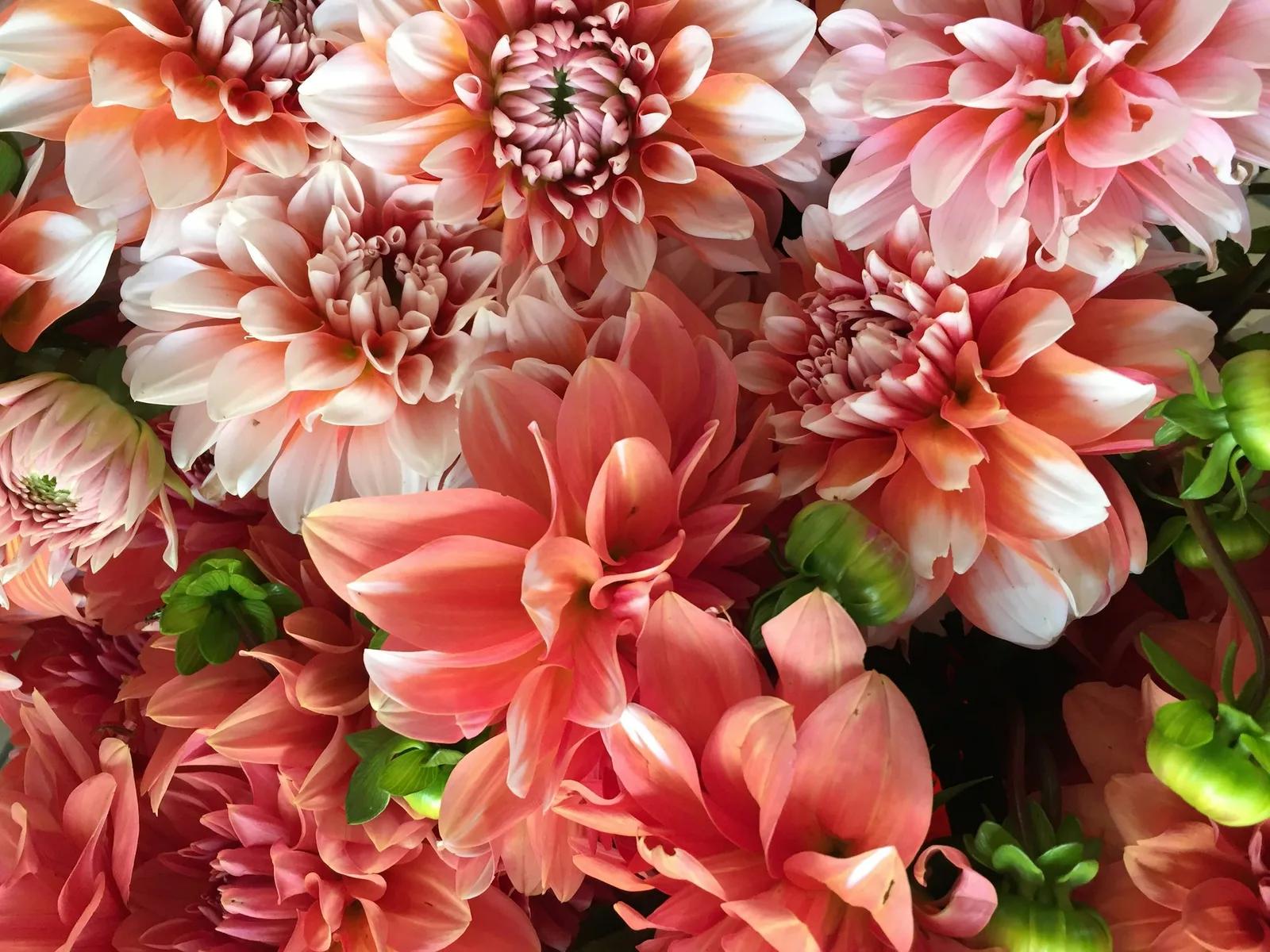
Peach, coral and blush dahlias, the late-summer and autumn flower with the fullness of a peony
In season: dahlias, asters, chrysanthemums, late garden roses, sunflowers and zinnias in September, amaranthus, celosia, Chinese lanterns, and hydrangeas turning antique green and burgundy.
Greenery and texture: rose hips, blackberries, crab apples, hypericum berries, beech and oak leaves, ornamental grasses, seed heads.
Good to know: in France, Italy, Spain, Portugal and Poland, among others, chrysanthemums are the flower of All Saints' Day and of graves, and older guests may read them that way; dahlias give the same fullness without the association. After the first frost, usually in October, outdoor dahlias are over and November leans on greenhouse flowers, berries and leaves.
Winter wedding flowers: December to February
Almost nothing flowers outdoors in Central Europe in winter, so a winter wedding builds on bulbs, greenhouse flowers, the Mediterranean and evergreens — and on candlelight, which does half the work.
In season: amaryllis, hellebores (the Christmas rose from December, the Lenten rose towards February), anemones and ranunculus from Italy and France, tulips, paperwhite narcissus, hyacinths, cymbidium orchids, and mimosa from January.
Greenery and texture: fir, pine, cedar, ivy, holly with berries, eucalyptus, cones and white snowberries.
Good to know: avoid the week of 14 February if roses are the heart of your flowers. Winter flowers last well, but a night in a freezing car or barn can ruin them.
What do wedding flowers cost in 2026?
Rough guide figures for much of Europe. Cities, Saturdays from May to September, out-of-season stems and long set-ups push you to the top of each range; smaller towns, Fridays and flowers in season keep you near the bottom.
Bridal bouquet: €80 to €250; a large, cascading or out-of-season bouquet €300 or more.
Bridesmaids' bouquets: €40 to €90 each.
Buttonholes: €10 to €30 each; wrist corsages €20 to €40.
Ceremony: a pair of large arrangements on stands, €150 to €400 each; an arch or floral installation, €400 to €1,500 and more; jars along the aisle, €20 to €80 each.
Tables: a group of bud vases, €25 to €60 per table; a full low centrepiece, €50 to €150; a runner of flowers and greenery along long tables, €40 to €100 per metre.
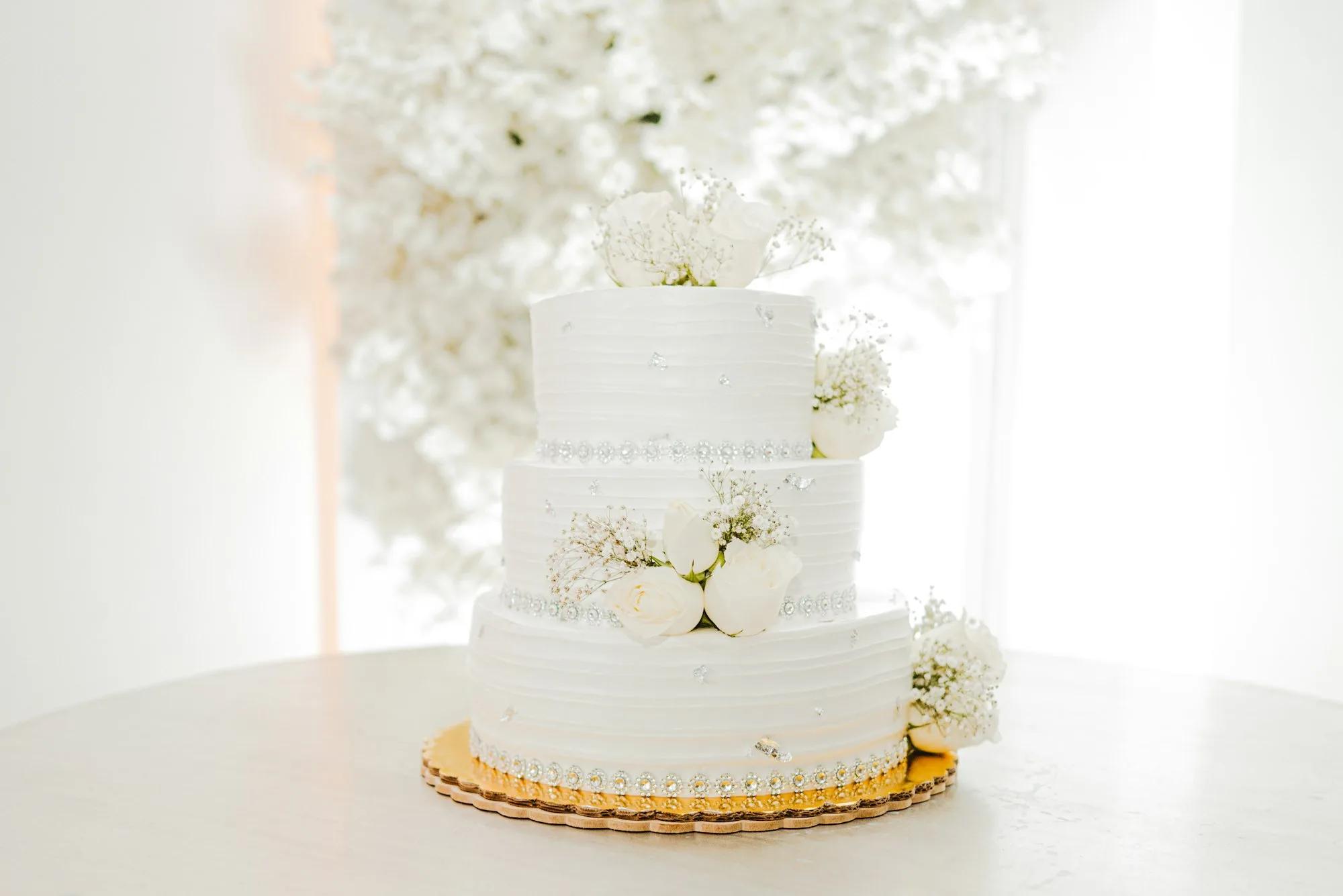
Cake flowers: €30 to €80.
Delivery, set-up and take-down: €50 to €300, more for a late-night collection or a long drive. Vases and stands are usually hired and collected afterwards.
Put together, 60 to 100 guests with a bouquet, buttonholes, ceremony flowers and every table dressed usually comes to €1,000 to €3,500. A small wedding with a bouquet, buttonholes and jars can stay under €600; arches and hanging installations reach €5,000 and beyond. How flowers sit beside everything else is in our guide to setting a wedding budget.
A worked example: 80 guests in September
Lena and Jonas marry on a Saturday in mid-September in a barn, with 80 guests at ten round tables. Their florist's quote:
Bridal bouquet of dahlias, garden roses, cosmos and rose hips: €160
Two bridesmaids' bouquets at €55: €110
Four buttonholes, for Jonas, both fathers and the best man, at €18: €72
Two large ceremony urns of dahlias, amaranthus and beech leaves at €190: €380
Six jars along the aisle at €25: €150
Ten tables, each with a low arrangement and three bud vases, at €55: €550
Flowers for the cake: €40
Delivery, set-up, moving the ceremony pieces and take-down: €220
That makes €1,682. During the drinks reception the urns move behind the top table and the aisle jars go to the bar, so the ceremony flowers dress the dinner too. Lena had pictured peonies, scarce in September; Café au Lait dahlias gave her the same full blush look for less. Once the florist is in their Planning, the Budget tool counts that price with the rest of their suppliers.
Bouquet, ceremony or tables: where your flower budget counts
The bouquet is in almost every picture of you, all day: the one piece that deserves the best stems.
The ceremony is the backdrop of your vows, but it is looked at for half an hour or so. Spend there on what can move afterwards.
The tables are where your guests spend three or four hours. Keep arrangements under about 30 cm, or high on a stand above eye level, so people can talk across the table.
Buttonholes and corsages are small but each is wired by hand. Keep the list short: the two of you, your parents, your witnesses.
Moving the ceremony flowers to the party
Plan it from the start: free-standing urns, flower meadows on the floor and aisle jars can move; a design fixed to an arch rarely can.
Decide where each piece goes: behind the top table, beside the cake, on the bar, at the entrance.
Decide who carries them and when, usually during a drinks reception of 60 to 90 minutes. A florist who stays charges for it, so ask for it in the quote and put the move in your wedding day timeline.
At the end, let guests take table flowers home, and dry the bouquet: hang it upside down in a dark, dry, airy room for two to three weeks.
Dried flowers and potted plants
Both take the season and the heat out of the question.
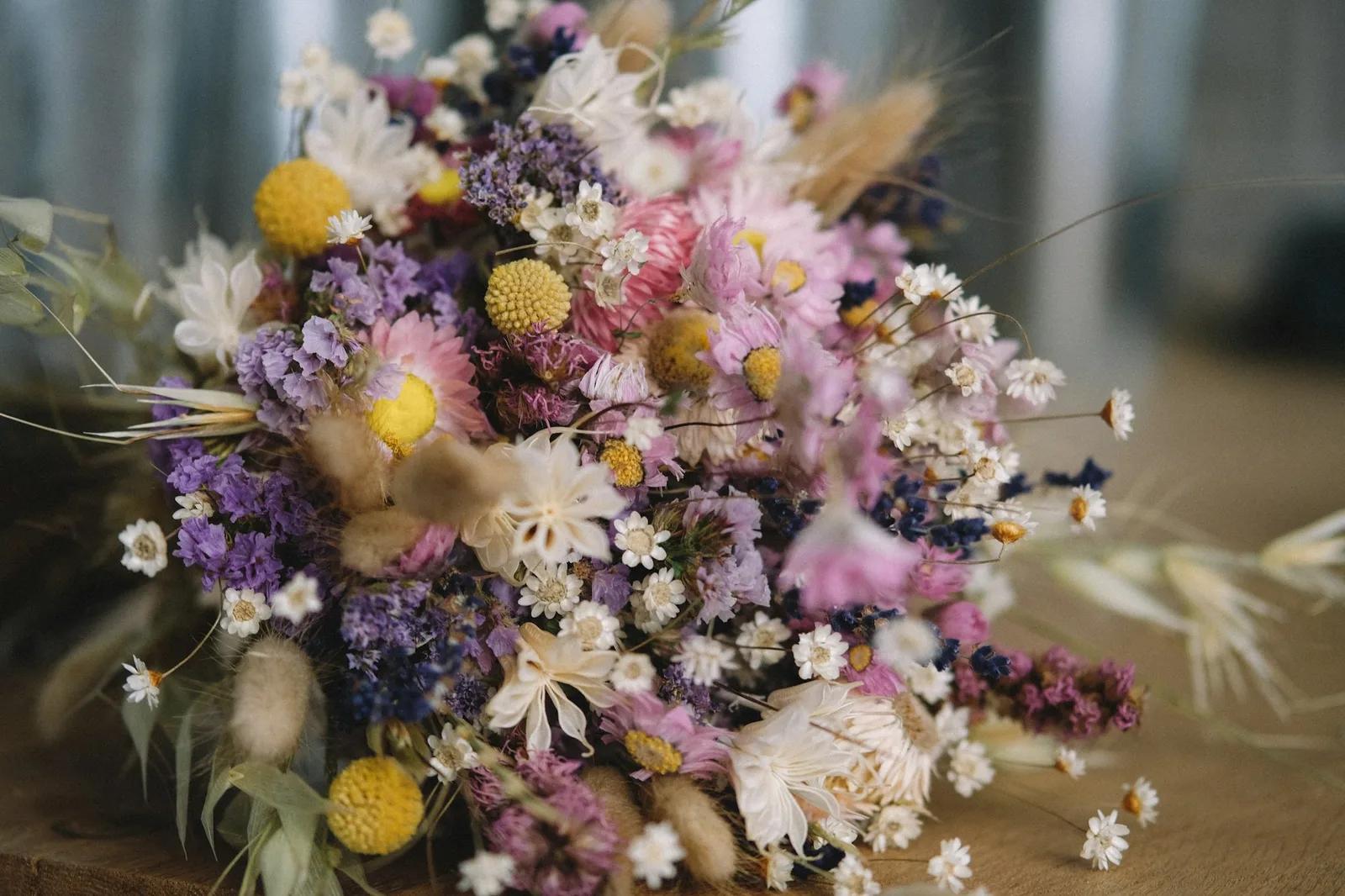
Dried flowers: bunny tails, statice, strawflowers, billy buttons, lavender, gypsophila, wheat, palm spears and eucalyptus. They are made weeks ahead, never wilt, and the bouquet keeps for years. They are brittle and burn easily, so keep candles away and check the venue's rules. Pampas grass (Cortaderia) is on Spain's official catalogue of invasive species; bunny tails or dried grasses give a similar softness.
Potted plants: rosemary, thyme and lavender in summer; olive and lemon trees; hyacinths and tulips in pots in spring; cyclamen, hellebores and orchids in winter. They never wilt, guests can take them home as favours, and large trees can often be hired.
A dried-flower bouquet of billy buttons, statice, strawflowers, lavender and bunny tails on a wooden table
Whichever you choose, ask for arrangements without floral foam, the green block florists push stems into. It is a plastic, and researchers at RMIT University found that it breaks into microplastics that water animals swallow. Chicken wire, pin frogs, moss and water tubes do the same job.
How to brief and book your florist
Book early for peak dates: a Saturday between May and September is the first to go.
Bring the facts: the date, the venue, guests and tables, the shape and colour of the dress, your colours, three to five pictures you love and one you don't, and your budget.
Give a palette, not a stem list: "blush, peach and burgundy, loose and garden-like" lets the florist buy what is best that week.
Ask what the price includes: delivery, set-up, take-down, vases and stands, moving the ceremony pieces, VAT, and what replaces a flower that is not good that week. Our questions to ask wedding suppliers has the full list.
Check with the venue: when the florist can get in, rules on candles and fixings, and what decoration is already there — part of choosing a wedding venue.
On Eventadore, every wedding florist is in the search, and so are decorators. With your date and number of guests, each card shows what that day costs, all in, travel included; without them, a price range (how prices for your day work). Once you add a florist to your Planning the price is locked, and reserving holds a booking fee on your card that is charged only when they say yes.
Frequently asked questions
What are the cheapest wedding flowers?
Whatever is in season near you, in quantity: tulips in spring, sunflowers and cosmos in summer, dahlias and asters in autumn. All year, carnations, spray roses, alstroemeria and gypsophila are inexpensive and long-lasting.
Can we have peonies at an autumn or winter wedding?
Sometimes, at a price. Their natural season in Europe is May and June; around the turn of the year some are flown in from the southern hemisphere, and in September and October they are hard to find at all. For the same full look, ask for Café au Lait dahlias in late summer and autumn, and ranunculus or double tulips in winter and spring.
How far ahead should we book a wedding florist?
For a Saturday between May and September, 6 to 12 months ahead; otherwise 3 to 6 months is usually enough. Give the final number of tables two to four weeks before.
Which wedding flowers cope best with summer heat?
Zinnias, sunflowers, lisianthus, sea holly, statice, celosia and alstroemeria hold well. Hydrangeas, sweet peas and gardenias suffer quickly. Ask for delivery as late as possible and keep everything in shade and water until the last moment.
Are dried flowers cheaper than fresh ones?
Not necessarily. The stems cost much the same and the florist's work is identical; what you save is the risk of wilting, because everything is made in advance. Fresh flowers with dried grasses often give the best of both.